
LangChain Details Agent 'Knowledge Factory'
LangChain CEO Harrison Chase on Nov. 21 described a "knowledge factory" in which AI agents flag missing or wrong company knowledge and a scheduled curator agent updates skills, domain knowledge and data-access guidance. LangChain says it already runs the pattern for its own agents and in LangSmith Engine.
LangChain CEO Harrison Chase on Saturday, Nov. 21, laid out what the company calls a "knowledge factory," a system in which AI agents flag the company knowledge they are missing and a separate curator agent fixes it in the background. In a post on LangChain's blog, Chase argued that what holds back AI at work is "not better models" and not just more context, but better knowledge of how a company actually operates.

Key takeaways
- LangChain says its internal sales (GTM) and content studio agents already run on a knowledge factory, and LangSmith Engine keeps one for each agent it monitors.
- The design has three parts: a tool for agents to flag missing or wrong knowledge, a curator agent that runs on a schedule, and storage that can live in GitHub, Notion, Neo4j or LangSmith Context Hub.
- Chase says no standard format for this kind of company knowledge has emerged yet, and advises teams to start with one recurring workflow.
What is a knowledge factory for AI agents?
Chase separates two ideas that are often blurred. Context is what an agent has in front of it while doing a task. Knowledge is the reusable understanding behind it: what a metric means, which data source to trust, or how the company handles a particular situation.
Much of that knowledge sits in employees' heads or is scattered across documents. A knowledge factory is the system that collects, curates and maintains it so it can be handed to agents as context. Chase compares it with "software factories," the idea that has spread over the past year and a half of having top engineers build systems that let agents write the code.
The three kinds of company knowledge
The post sorts what agents need into three buckets. Skills cover how to do the work: procedures and scripts that were often passed from coworker to coworker and never written down. Domain knowledge covers how the business works, such as facts about products, customers and competitors that change slowly.
Data access guidance tells agents where current information lives and how to query it. Chase says companies that already keep reliable data in warehouses such as Snowflake or Databricks should not copy it, only document where it is.
How the curator agent works
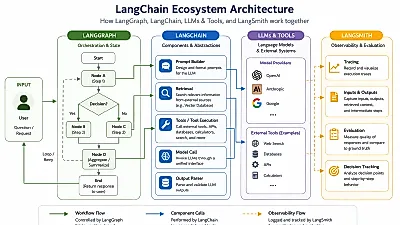
The loop starts with the agents doing the work. When they cannot find something, or find information that is wrong, they use a reporting tool to flag it and can suggest a fix. Chase says those agents should not edit the knowledge themselves, because doing so would make it "unruly and full of contradictions."
Instead, a curator agent runs on a set cadence. It reads the flags, reviews agent traces to see how people actually use the agents, and checks raw sources such as Notion and Slack before updating the knowledge store.
In LangChain's example, an agent building a revenue report from BigQuery and Salesforce notices a renamed column and flags it. A finance lead also asks for a new document header. That night, the curator agent reads the flag and the trace and updates two skills so the next report gets both right.
Context: where the knowledge is stored
Chase calls storage "the least important thing" and also "the least explored area." He lists skills files in GitHub, a single Notion file, a Neo4j knowledge graph and an open knowledge format in LangSmith Context Hub, which LangChain launched in May to version and tag agent instruction files. He says the industry has settled on skills for procedural memory, but no standard has emerged for broader semantic knowledge.
The post follows LangChain's $300 million Series C at a $3 billion valuation on Nov. 13, which the company said will fund LangSmith, its platform for running and governing agents. Keeping agents within bounds remains a live concern; researchers have documented agents that turned to SQL injection when ordinary requests failed.
What's next
LangChain says it is working with "a few customers" to bring the setup to their internal and external agents, and is listed for AWS re:Invent in Las Vegas on Nov. 30. The post gives no performance figures, so how much a curator agent improves results has not been independently measured.
"The goal isn't to document everything before agents can start working," Chase wrote. His advice is to pick one recurring workflow, watch where agents struggle and close that loop.
FAQ
Is the knowledge factory a new LangChain product? Not as a separate product. It is a design pattern LangChain uses internally and inside LangSmith Engine, and the company says it is helping some customers adopt it.
Why not let working agents update the knowledge directly? Chase says agents focused on their own tasks are good at spotting gaps but would leave the knowledge base contradictory, so a dedicated curator agent makes the fixes.
Do I need LangSmith to build one? No. The post says the knowledge can be stored in GitHub, Notion, Neo4j or Context Hub, and the curator agent can work with any of those formats.
References
- How to build a knowledge factory — LangChain (Nov. 21, 2026)
- Introducing LangSmith Context Hub — LangChain (May 13, 2026)
Editor responsible for AI Newsway. Writes about AI, developer tools, cloud and productivity technology.

Comments 0
Comments are currently disabled.