
OpenAI Agents Finish 46% of 2-4 Hour Tasks
OpenAI said on Nov. 18, 2026, that its coding agents now complete an estimated 46% of two-to-four-hour research tasks without human help, up from 23% in March, but success ranges from 79% to 25% by task. Median researcher agent use hit $2,400 a day at API list prices.
OpenAI said on Wednesday, Nov. 18, 2026, that its coding agents now complete an estimated 46% of research tasks that would take a person two to four hours, with no human stepping in, double the 23% rate it measured in March. The figures come from "Research acceleration: The jagged frontier," the company's second report on how AI is speeding up its own research.
Key takeaways
- Zero-intervention success rose from 23% to 46% on two-to-four-hour tasks and from 13% to 35% on four-to-eight-hour tasks between March and October.
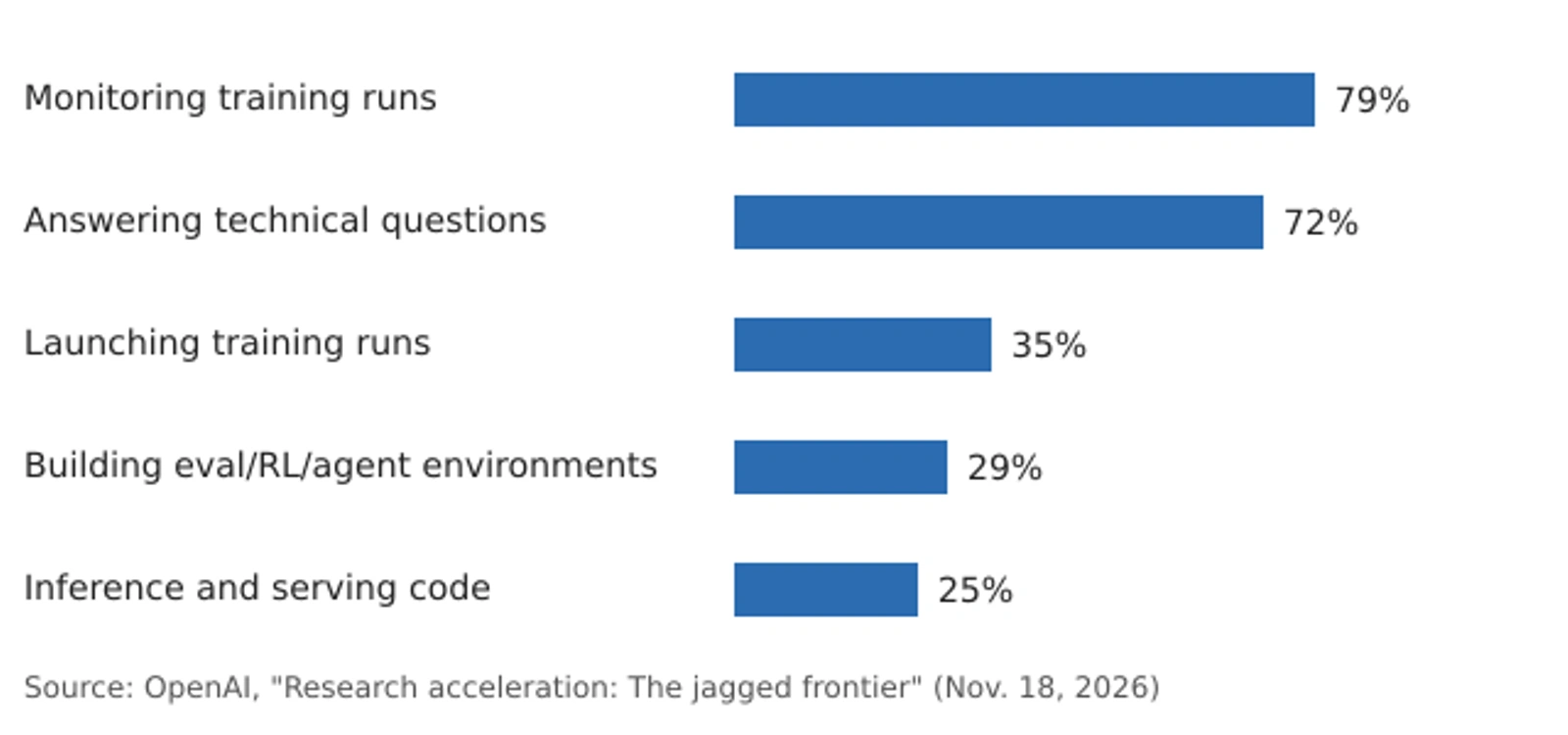
- Results vary widely by task: 79% for monitoring training runs, but 25% for writing inference and serving code.
- At API list prices, the median researcher used $2,400 of agent time a day in October; the 90th percentile used $23,000.
How often OpenAI coding agents finish research tasks alone
OpenAI groups delegated tasks by how long a human would need. For four-to-eight-hour jobs, the zero-intervention success rate climbed from 13% in March to 35% in October. The company cautions that researchers may also have changed which tasks they hand off, so the gains reflect both better models and better delegation.
The task-level picture is what gives the report its title. From Aug. 1 to Oct. 18, agents succeeded alone 79% of the time when monitoring training runs and 72% when answering technical questions. They managed 35% when launching training runs, 29% when building evaluation, reinforcement-learning and agent environments, and 25% when writing code for inference and serving stacks.
"So long as model performance on AI R&D-related tasks is heterogeneous, lower-performing categories and tasks could become bottlenecks to high overall uplift," OpenAI wrote.
Agent spending and workdays per researcher
Use is still climbing fast. Valued at API list prices, the median researcher's daily agent use reached $2,400 in October, up 62% from $1,500 in September. At the 90th percentile it hit $23,000, up 105% from $11,000. OpenAI notes researchers have no agentic coding quotas.
Counting eight hours of agent runtime as one "agent workday," the average rose from 0.5 to 5.7 per researcher per day, an elevenfold increase. Pretraining and posttraining teams averaged about eight. By mid-October, more than two-thirds of researchers peaked at four or more concurrent agents a day, and more than 10% at 16 or more.
In September, the API-equivalent value of agent use was about twice the research organization's non-equity pay, which excludes equity worth 70% to 80% of target compensation. Internal deployment still accounted for only 2% of total research compute.
What researchers say they would give up
In a survey of 101 research staff from late August to early September, the median respondent said they would trade 40% of team headcount, or 30% of team compute, to keep agents better than GPT-5.2 for three months. Interviews also flagged weak spots, including "AI slop" pull requests and poor research taste. "I do think I have more taste in terms of the ideas. But I have no confidence that will continue to be true for any significant period of time," one pretraining researcher said.
Context: from 'research intern' to recursive self-improvement
The update follows OpenAI's Sept. 6 report, in which it said it had reached its goal of an "automated research intern." Its next stated target is an automated AI researcher by March 2028. Outside benchmarks have been less upbeat: one found agents barely improve training algorithms on their own.
OpenAI argues that AI labs should be required to track and publicly report indicators of recursive self-improvement, while saying its reporting "should not be read as an intention to pursue full RSI." It also said documented Safety and Alignment work rose 77% from January to September.
What's next
OpenAI said future reports may compare how fast capabilities research is accelerating against safety research and look for leading indicators of uplift. All figures are the company's own internal estimates and have not been independently audited.
FAQ
What does "jagged frontier" mean here? That agent performance is uneven: strong on monitoring and answering questions, weak on serving code and building environments.
Are agents replacing OpenAI researchers? OpenAI says no. It describes humans as "a core part of the AI research loop" and says people still came up with most key model ideas.
Are the dollar figures real costs? No. They value agent use at public API list prices, not OpenAI's internal compute cost.
References
- Research acceleration: The jagged frontier — OpenAI (Nov. 18, 2026)
- Research acceleration: The view inside OpenAI — OpenAI (Sept. 6, 2026)
Editor responsible for AI Newsway. Writes about AI, developer tools, cloud and productivity technology.

Comments 0
Comments are currently disabled.