arXiv began limiting every submitter to two papers per calendar month on October 1, a stopgap the preprint server introduced after receiving 40,363 submissions in September — a single-month record and roughly double its volume from two years earlier. The repository says the surge is driven in part by authors using AI tools, and that the cost is being paid by its volunteer moderators.
Key takeaways
- From October 1, 2026, arXiv allows each submitter two submissions per calendar month, on top of a three-active-submission ceiling that has been in force since 2024.
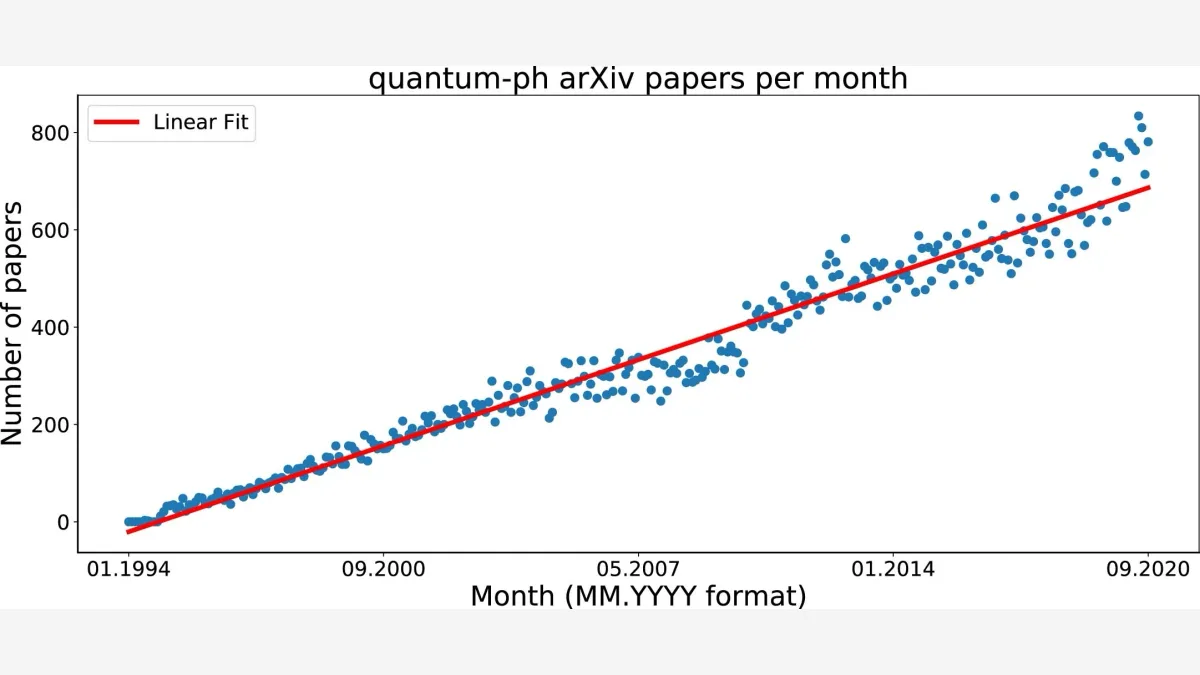
- September 2026 brought 40,363 submissions, against 20,569 in September 2024 and 9,869 in September 2016, and generated almost 9,000 support tickets.
- Submissions to the cs.AI category have risen more than sixfold in two years, while other arXiv categories merely doubled.
What the new limit actually restricts
The cap counts submissions, not announced papers. arXiv is explicit that a rejected manuscript still burns a monthly slot, because it is the act of submitting — not publishing — that consumes moderator attention. The limit applies across every subject area, so an author cannot spend one slot in physics and another in computer science and then open a third in mathematics.
Two carve-outs soften it. Only the submitting author is charged, so a paper posted on behalf of five co-authors leaves the other four untouched; arXiv asks groups to coordinate who files what. And a manuscript deleted before it is announced does not count at all, which gives authors room to withdraw something they filed prematurely.
Papers left on hold at a month boundary sit in an awkward middle. They do not count against the new month's two-submission allowance, but they do still occupy one of the three active slots, so a backlog in moderation can quietly throttle an author's throughput anyway.
Taken at face value, the arithmetic puts a hard ceiling of 24 submissions a year on any individual filer. For most researchers that is far above their actual output and the rule will never bind. For the heavy-volume accounts arXiv says it is targeting, it is the whole point — and it is the first time the repository has attached a number to a threshold its moderators previously enforced case by case.
Why volunteer moderators are the bottleneck
arXiv runs its quality screen on unpaid volunteers, and the repository says a relatively small group of authors filing a large number of weak papers is absorbing a disproportionate share of their time. The practical consequence is a delay for everyone else: submissions that would have cleared quickly instead wait days or weeks behind the queue.
Three failure modes get named in the announcement. Thin papers of narrow scope. "Salami" papers, where one piece of work is sliced into several smaller submissions. And dense, AI-written manuscripts. arXiv's policy does permit authors to use AI as a research tool so long as the use is disclosed and the work still meets its standards for originality and scholarly interest — the problem, by its own account, is the growing share of submissions that clear neither bar. Thomas Dietterich, Distinguished Professor Emeritus at Oregon State University and chair of arXiv's Editorial Advisory Council, is cited in the post.
The second AI-driven rule arXiv has written this year
This is not arXiv's first move against machine-written filler. In May 2026 it introduced a one-year submission ban for authors whose papers carry clear evidence of unverified LLM output — invented citations, placeholder text, or leftover model meta-comments such as a request to confirm edits. Dietterich, who also chairs arXiv's computer science section, framed that policy around "incontrovertible evidence" rather than detector scores.
It drew a sharper reaction than the new cap has. Critics worried about false positives falling on non-native English speakers and about whether every co-author would be punished for one person's shortcut. The volume problem the rate limit addresses is the same pressure measured from a different angle — and it rhymes with findings outside academia, where Pew found 35% of web pages published after ChatGPT show signs of AI authorship.
What happens next
arXiv, which became an independent nonprofit in April 2026, is framing the cap as temporary. It says the limit buys time to improve its moderation tooling and procedures while it works out what submission norms should look like for authors using increasingly capable AI assistance, and that it will monitor the policy's effect on authors and the corpus and revise as needed. Read the full policy announcement on the arXiv blog.
FAQ
Does a rejected paper count against the two-submission limit?
Yes. The cap is measured at the point of filing, not at announcement, so a manuscript that fails screening has still spent the slot. An author whose two monthly attempts are both turned away waits until the next calendar month before trying again.
Does the limit apply to co-authors as well as the submitter?
No. arXiv's rate limits apply only to the person who files the paper. A co-author on a submission someone else posted keeps their own full allowance, though arXiv asks collaborators to coordinate so a group does not stall itself.
Is the three-active-submission cap new?
No. arXiv has enforced a limit of three simultaneously active submissions since 2024, and that rule is unchanged. The new element is the separate ceiling of two submissions per calendar month, effective October 1, 2026.