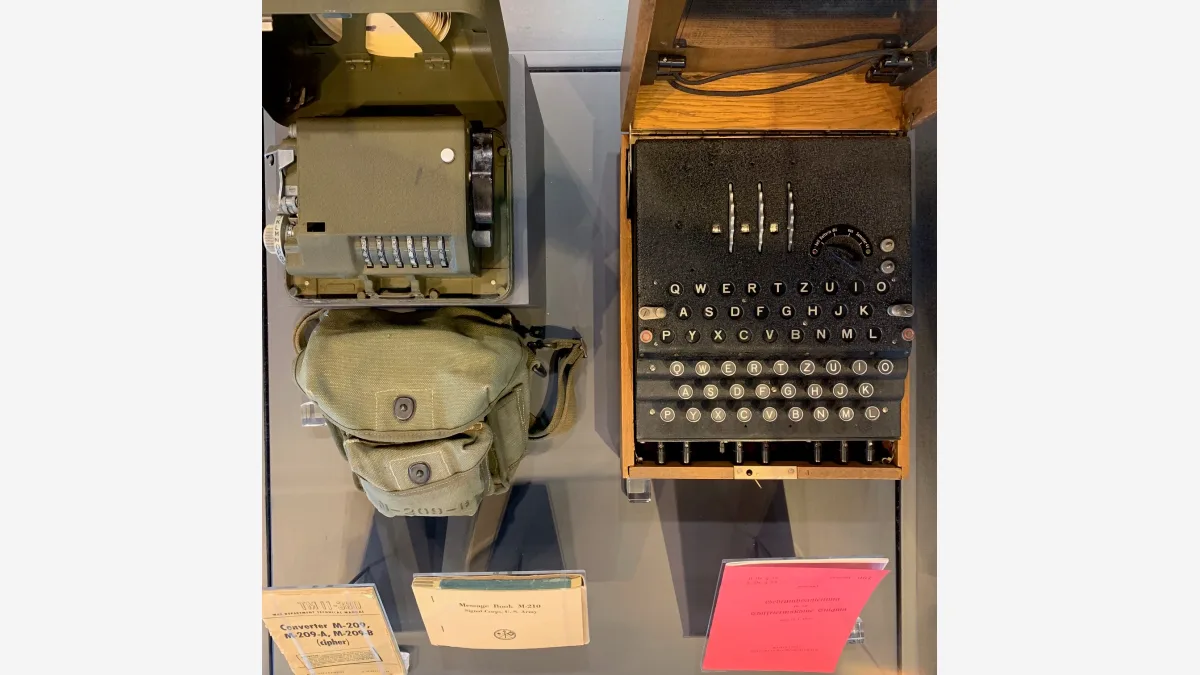
An Enigma-enciphered German Army radio message from 10 July 1941 that had sat on cryptanalyst Frode Weierud's unbroken list since 2005 has finally been read, and the codebreaking was done by OpenAI's GPT-6 Astra. Weierud, who maintains the Crypto Cellar Research archive, validated the solution after being contacted on 15 September 2026 by Carter Leffen, a product development coach at Bloomberg LP.
The message runs 82 letters and is identified by its indicator MVUEH. It was transmitted by a station using the tactical callsign 2ny and logged as incoming message Nr. 172 by the SS-Totenkopf division's Quartiermeister radio station at 17:30 the same day. The plaintext turns out to be mundane: a request to specify a march route, a note that the sender is at Rosenow, and a demand for an immediate radio reply.
Key takeaways
- MVUEH used wheel order 253, unlike every other message broken from 10 July 1941, which used wheel order 512.
- GPT-6 Astra wrote its own Enigma simulator and software Bombe in Python and C++, then ran the break using the repeated place name ROSENOW as a crib.
- Weierud's account describes an unprompted, end-to-end break; Leffen's own write-up describes a human setting goals while AI agents handled evidence, search and review.
Why MVUEH held out for two decades
Every other message recovered from 10 July 1941 used the same wheel order, 512. MVUEH did not. Its key used wheel order 253, along with different plug connections and a different ring setting. A 2017 break of the neighbouring message Nr. 173, indicator SIPVX, by Alex Shovkoplyas had already surfaced a key that deviated from that day's settings, but applying it to MVUEH produced nothing.
Two further obstacles only became visible after the fact. The transcription of the ciphertext from the original message form contained several errors, and the Enigma's left-hand wheel stepped over at the 72nd letter — a rare event that badly complicates a search. Weierud believes those two factors are why earlier attempts failed.
How the break was done
Enigma offered roughly 159 quintillion daily settings, so brute force was never an option. The route in was a crib: the already-solved SIPVX message contained the place name Rosenow twice in a row, and the same phrase was guessed to appear in MVUEH. The machine's defining weakness — it never encrypts a letter as itself — ruled out most crib alignments immediately.
At one alignment everything fit. The recovered settings resolved the remaining characters into coherent German, including Angabe des Marschweges and Sofort Funkantwort. A separately preserved message header confirmed the key.
MVUEH's plaintext proved almost identical to SIPVX's. The two differ by twelve letters because the operator garbled Bitte as Btte in MVUEH, and because the signature Waschbusch is repeated in SIPVX. Leffen treats the surviving typos — BTTE, WASCHBBSCH — as evidence the solution is genuine, on the grounds that a fabricated plaintext would read cleanly.
How autonomous was it
This is where the two accounts diverge. Weierud writes that GPT-6 Astra did the work entirely on its own: it picked MVUEH out of the unbroken list as the most promising target, suspected a relationship with SIPVX, and settled on the Rosenow crib after other approaches failed. Leffen's own write-up, summarised by The Decoder, is more measured — he describes setting the goals and making the calls while specialised agents handled evidence gathering, search and cross-checking.
Both accounts agree on the scale of the effort. Roughly ten hours of model time went into the problem, using the "Extra High" variant. Weierud, who spent weeks researching the Bundesarchiv holdings the model later referenced, says what it achieved in two days would take a human researcher weeks or months. Leffen says he put ninety-nine times more work into the website explaining the result than into the break itself.
What comes next
Weierud is still reading the model's logs, and one entry is already notable. GPT-6 Astra cited Bundesarchiv file references RS 3-3/20a and RS 3-3/63b, which are correct but appear nowhere on the Crypto Cellar site; how it obtained them is unclear. The published packages reproduce the key search and verify the arithmetic, but they do not establish that the solution is unique or that the historical attribution is airtight, so independent review is still pending. The result lands in the same week as other claims about the model's reach into open-ended work, including OpenAI's push to sell Astra on computer use.
FAQ
Did GPT-6 Astra break Enigma itself?
No. Enigma was first broken in 1932 by the Polish mathematician Marian Rejewski, and the general method has been public for decades. What is new here is the recovery of the specific key for one message that had defeated every attempt since 2005.
Can the result be independently checked?
Partly. Leffen published code, search data and a working Enigma simulator, and those packages replicate the key search and verify the calculations. They do not prove the plaintext is the only possible solution or confirm the message's historical identity, so full verification depends on other cryptanalysts reviewing the material.
Is the decrypted message historically significant?
Not in its content. It is a routine logistics query about a march route from a sender at Rosenow. Its interest is methodological: it shows an AI system running an end-to-end cryptanalytic campaign, from target selection through tool building to validation.