
Apple Pushes On-Device AI With 512GB Mac Studio and M5 Ultra
Apple introduced a new Mac Studio on August 25 built around the M5 Max and an all-new M5 Ultra, and the configuration Apple is pushing hardest is aimed squarely...
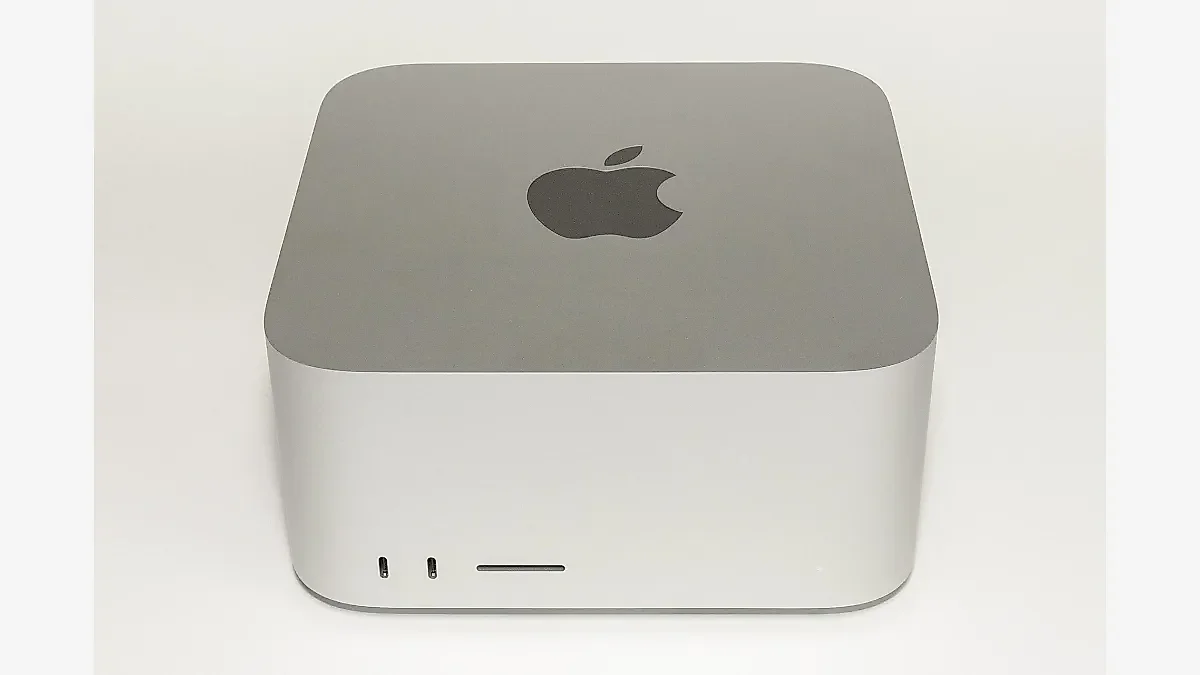
Apple introduced a new Mac Studio on August 25 built around the M5 Max and an all-new M5 Ultra, and the configuration Apple is pushing hardest is aimed squarely at people running large language models without touching a data center: up to 512GB of unified memory, moving at 1.2 terabytes per second.
Key takeaways
- The M5 Ultra Mac Studio tops out at 512GB of unified memory with 1.2TB/s of bandwidth, 50 percent more than the M3 Ultra it replaces.
- Apple rates the M5 Ultra GPU at up to 4.5 times the peak AI compute of the M3 Ultra, with a Neural Accelerator built into every one of its up-to-80 GPU cores.
- Pre-orders opened August 25 from $5,499, general availability is September 22, and the 512GB configurations arrive in late October.
At the top end the M5 Ultra pairs a 36-core CPU with an 80-core GPU. Apple rates that GPU at up to 4.5 times the peak AI compute of the M3 Ultra, and it is the first Ultra chip to carry a Neural Accelerator in every GPU core. The memory bandwidth figure is 50 percent higher than the M3 Ultra as well, and in a unified memory architecture that number does more work than the core counts do.
Why the memory number is the headline
On a machine with unified memory, the model and the data share one pool. There is no copying weights across a bus into separate video memory, which is exactly the bottleneck that makes running very large models awkward on conventional desktop hardware.
Apple's pitch follows from that: with 512GB available, a model with hundreds of billions of parameters can sit entirely in local memory, and entire datasets can stay resident while the machine works through them. Bandwidth then sets how fast tokens come out the other side.
Bandwidth matters here for a structural reason. Generating each token requires reading the model's weights, so on large models the memory system, not the arithmetic units, tends to be what limits speed. Raising bandwidth by half against the previous generation lifts that ceiling directly.
Buyers who do not need the full configuration can take the M5 Max version of the same machine, which shares the chassis and the unified memory approach at up to 128GB.
Who this is actually for
This is not a mainstream configuration and Apple is not pretending otherwise. The audience is researchers and developers who want to iterate against a large model without metering every request, along with professional workflows where the data cannot leave the building.
Apple points to setups where a local model drives simulation work in tools like MATLAB, with the model and the workload living on the same desk. Thunderbolt 5 handles the external connectivity around it, and Apple says it also lets several Mac Studio systems be clustered over RDMA into a shared memory pool, with four machines reaching up to three times the inference throughput of one.
How the Mac Studio compares to other local AI hardware
The timing places Apple inside a broader move toward local inference rather than ahead of it. Nvidia has been pushing DGX Spark as a desktop-class AI machine, and Perplexity shipped a fully local version of its agent platform on that hardware the same week, as covered in our report on the agent that runs on your own GPU and bills you nothing.
What separates the Mac Studio configuration is the memory ceiling. DGX Spark ships with 128GB of unified memory, and most other desktop AI hardware is similarly constrained by how much model you can fit before performance falls off. A 512GB addressable pool changes which models are candidates in the first place.
Price and availability
Pre-orders opened on August 25, with the M5 Ultra Mac Studio starting at $5,499 and general availability on September 22. The M5 Max version starts at $2,499. The 512GB configurations arrive later, in late October. Apple also introduced the M6, its first chip on a 2-nanometer process, in the same announcement cycle, positioning M5 Ultra as the compute ceiling of the current desktop line rather than the leading edge of the silicon roadmap.
Whether local inference becomes standard practice or stays a specialist choice will be decided by economics more than hardware. But the direction is consistent across three very different companies in a single week, and that is usually a signal worth reading.
FAQ
How large a model can the 512GB Mac Studio run?
Apple says a model with hundreds of billions of parameters can sit entirely in the 512GB unified memory pool. The practical ceiling depends on precision, because quantization stores each weight in fewer bytes, so the same 512GB holds a substantially larger model at 4-bit than at 16-bit.
Is the M5 Ultra faster than the M3 Ultra for AI work?
Apple rates the M5 Ultra GPU at up to 4.5 times the peak AI compute of the M3 Ultra. Memory bandwidth also rises 50 percent to 1.2TB/s, which matters more than raw compute for token generation on very large models, since generating each token requires reading the weights.
When can you buy the 512GB Mac Studio?
Pre-orders opened on August 25, 2026 and general availability is September 22. The 512GB configurations ship later, in late October. Pricing for the M5 Ultra model starts at $5,499 in lower memory configurations.
Editor responsible for AI Newsway, operated by ZZEM. Writes about AI, developer tools, cloud and productivity technology.
Comments 0
Comments are currently disabled.