
OpenAI Models Found Up to 14% Gain in AMD GPU
OpenAI said Nov. 18 its models found up to 14% PPA gains on AMD's flagship GPU design and cut standard-cell area about 13% in Jalapeño's warp engine.
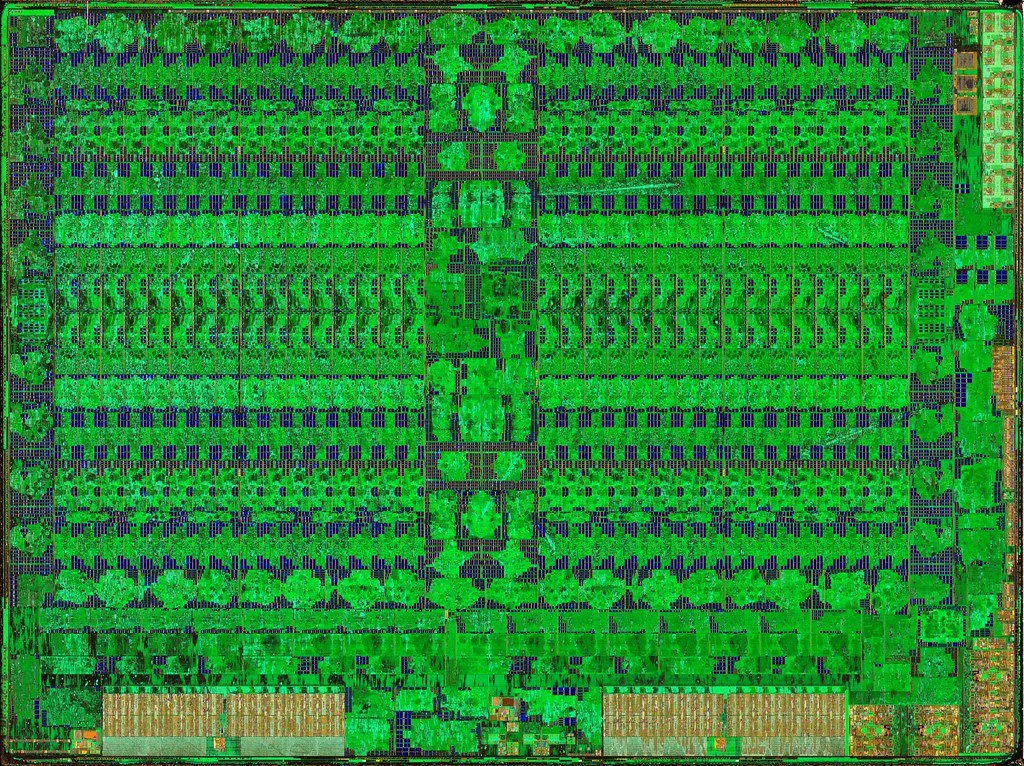
OpenAI said on Nov. 18 that its models found power, performance and area (PPA) improvements of up to 14% on AMD's flagship GPU design, measured against what it called heavily optimized baselines. The disclosure, in a research post titled "Advancing chip design with OpenAI models," also put the first detailed numbers on how much AI-proposed changes shrank OpenAI's own Jalapeño inference chip.
Key takeaways
- OpenAI reports up to 14% PPA improvement on AMD's flagship GPU IP after its model rewrote SystemVerilog RTL; AMD has put some changes into a design already sent for manufacturing.
- On Jalapeño, OpenAI estimates model-proposed changes cut standard-cell area by about 13% in the warp engine and 10% in the matrix unit, gains it says were silicon proven.
- OpenAI is now training GPT-Synopsys with Synopsys so a model can drive commercial electronic design automation (EDA) tools directly.
How AI chip design worked on AMD's GPU
According to OpenAI, its model improved AMD's GPU blocks by rewriting the code that describes the chip's circuits, then used Synopsys tools to check that each rewrite preserved the block's behavior and to weigh trade-offs in power, performance and area.
OpenAI described the result as "roughly a year of progress achieved in less than 5 months." It said AMD included some of the changes in a recent design sent for manufacturing and added others to production design files for future versions. AMD also verified single-digit percentage PPA gains across key blocks of its upcoming next-generation flagship CPU, OpenAI wrote. AMD has not published its own figures on the work.
Jalapeño: 15% smaller multiplier, one cycle faster
OpenAI said it began using GPT-4o to help design Jalapeño, its first custom inference chip, in early 2025. In the matrix unit, one multiplier redesign used about 15% less cell area in synthesis while cutting latency from two clock cycles to one. A separate adder redesign also saved about 15% of cell area while keeping its two-cycle latency.
Savings in the warp engine, which manages parallel computing tasks, came from floating-point adders and multipliers, conversion functions, reduction logic and the special-function unit.
RISC-V benchmark: GPT-6.2 Astra leads
To track progress across model generations, OpenAI tested models on two open-source 32-bit RISC-V cores: PicoRV32, a compact core for FPGAs, and Ibex, the embedded processor in the OpenTitan security chip. Designs scored zero if they failed a check or used more than 16 times the original core's area.
At a budget of about 112,000 tokens per run, GPT-6.2 Astra had the highest average score on both cores, roughly twice GPT-6 Astra's on PicoRV32. When asked to design a core from a written specification instead of improving existing code, all five models scored higher. OpenAI cautioned that spec-based designs could drop features such as performance counters, which may explain part of that edge. The evaluation covered 9,881 scored runs.
Why it matters
The figures are self-reported by OpenAI, and the RISC-V tests are internal benchmarks rather than independent ones. Still, the AMD result is notable because it targets production designs that expert teams had already tuned. The two companies agreed in October 2025 on a deal for OpenAI to deploy 6 gigawatts of AMD GPUs, starting with the Instinct MI450 series.
What's next
OpenAI said it is partnering with Synopsys to train GPT-Synopsys to use Synopsys EDA tools the way expert chip designers do. Under the multiyear deal announced Sept. 30, OpenAI licenses Synopsys tools, the companies share revenue, and the model will run on OpenAI-hosted infrastructure. Synopsys said early evaluations with key customers were already underway and that customer data would not be used for model training.
FAQ
What does PPA mean in chip design?
PPA stands for power, performance and area, the three main measures engineers trade off when designing a chip. Smaller area generally lowers cost per chip.
Is AMD shipping chips with OpenAI's changes?
OpenAI says AMD included some changes in a recent design sent for manufacturing. It did not name the product or say when it will ship.
What is GPT-Synopsys?
A specialized model OpenAI and Synopsys are developing to operate Synopsys EDA tools, read their outputs and iterate on designs, with engineers reviewing the results.
References
- Advancing chip design with OpenAI models — OpenAI (Nov. 18, 2026)
- OpenAI とシノプシス、GPT Synopsys を発表:最先端のAI技術でチップ設計を刷新 — Synopsys (Sept. 30, 2026)
- AMD と OpenAI 、 6 ギガワット規模の AMD 製 GPU 導入に向けた戦略的パートナーシップを発表 — AMD (Oct. 6, 2025)
Editor responsible for AI Newsway. Writes about AI, developer tools, cloud and productivity technology.

Comments 0
Comments are currently disabled.