Anthropic said on Wednesday that Claude autonomously identified a previously uncharacterised enzyme system in bacteriophage DNA, a find the company is publishing as a pre-print alongside the debut of an in-house life sciences research group and wet lab.
Key takeaways
- Roughly 950 Claude agents spent 21 hours and 210 million tokens combing a DNA sequence database, gathering more than 200,000 reverse transcriptases and narrowing 3,500 candidate systems to 20 written reports.
- One agent flagged a tandem repeat array sitting beside an unusual reverse transcriptase — a layout reminiscent of CRISPR — which Anthropic now calls array-associated reverse transcriptases, or ART.
- CRISPR pioneer Feng Zhang, who reviewed the pre-print, called the RNA-repeat arrays genuinely intriguing and said the finding merits further investigation.
What Claude actually found
Reverse transcriptases copy RNA back into DNA. Hundreds of families have been catalogued in recent years, most of them in bacteria, where they form part of microbial immune systems. Nearly all were found by genome mining: searching sequence databases for uncharacterised genes, noticing the odd ones, and working out what they do.
The RT at the centre of this system, found in a jumbo phage, had already been described in earlier studies. What nobody had recorded were its neighbours — an array of evenly spaced non-coding DNA repeats and an accessory protein of unknown function. Taken together, those three parts give ART a combination of features that has only ever been seen in a handful of systems, all of which are programmable and can cut, copy or paste DNA. Anthropic's first experiments show the ART array is transcribed into a set of distinct short RNAs, which is how CRISPR arrays supply the guide sequences that make CRISPR-Cas tools targetable.
The function of ART remains unknown, and the company is explicit about that. Further experiments are under way.
How the search was run
Human direction stopped at the prompt. Scientists asked Claude to look through a large DNA sequence database for interesting new RT examples; from there the agents chose which families to investigate and which candidates were worth a report. Anthropic says the run consumed about 21 hours across roughly 950 agents and 210 million tokens, and that the same analysis would take an expert weeks to months.
The moment of detection is recorded in the agent's own transcript, which reads more like a graduate student than a pipeline: it described the sequence as spectacular and said it could see a tandem repeat array by eye. It then counted the repeats, measured their spacing, compared the layout against known RT systems, searched the literature for prior reports, and filed a report for human review.
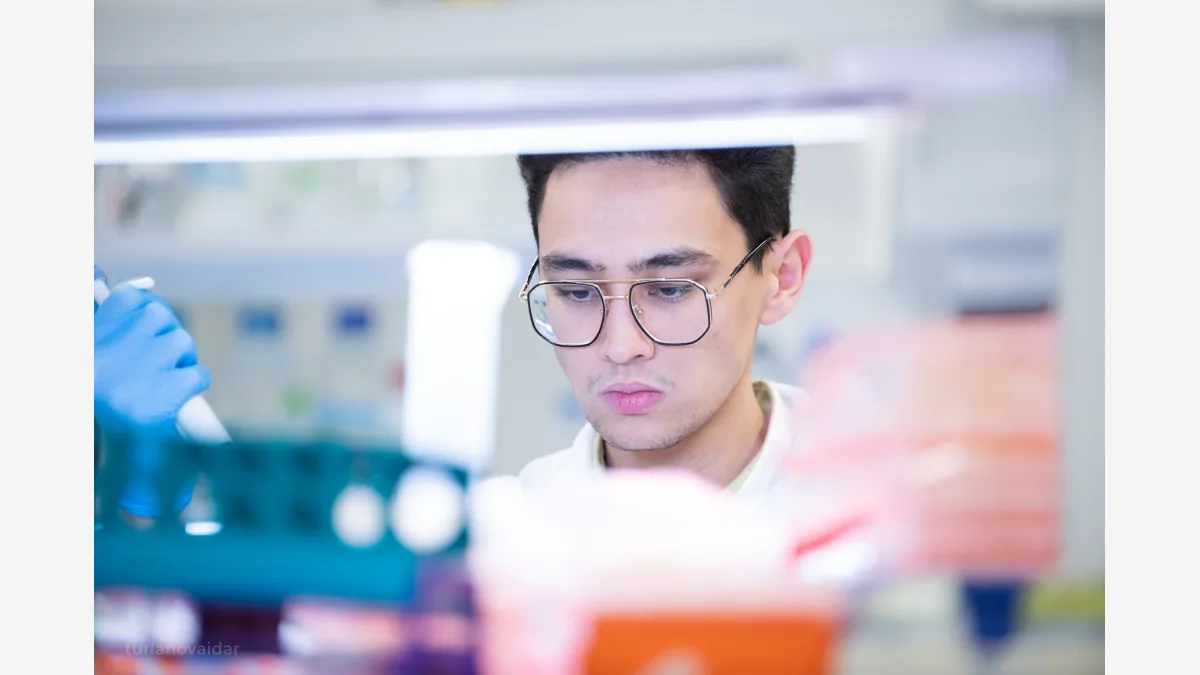
That review is the throttle. Claude reads the relevant papers, reproduces established results from public data to check its own methods, proposes a function for each candidate with supporting evidence, then critically re-examines the evidence — a stage at which most candidates are eliminated. A survey may end with one candidate worth testing, or none. Lab work is done entirely by human scientists at a Bay Area facility restricted to BSL-1 and BSL-2 work, with no human pathogens, which the company confirmed earlier this month.
Why it matters
Hypothesis generation has become cheap enough that Anthropic now studies the hypotheses themselves, asking what separates the proposals worth testing from the ones its scientists discard, and folding the answer back into Claude's instructions. That is a different claim from "AI made a discovery": the scarce resource has moved from generating candidates to triaging them.
Zhang's endorsement in Anthropic's announcement is measured — intriguing, worth investigating — not a claim that a new gene-editing tool has arrived. Whether ART turns out to be programmable is an empirical question that will be settled in a lab, not in a token budget. Anthropic says it wants outside researchers to bring it problems in genomics and other fields.
FAQ
Is ART a new gene-editing tool like CRISPR?
Not yet, and possibly never. ART shares a structural pattern with CRISPR — an enzyme paired with an array of DNA repeats that is expressed as short RNAs — but its biological function has not been determined. Anthropic says experiments to work out how it operates are still running.
Did Claude do the laboratory work?
No. All bench work is performed by human scientists in Anthropic's Bay Area lab. Claude handled the database search, candidate triage and report writing, and helps interpret experimental data afterwards.
Where can the underlying work be read?
Anthropic has released a pre-print and a technical report covering the ART system in more detail, both linked from its announcement post. The company describes the results as early and is sharing them before the system's function is understood.