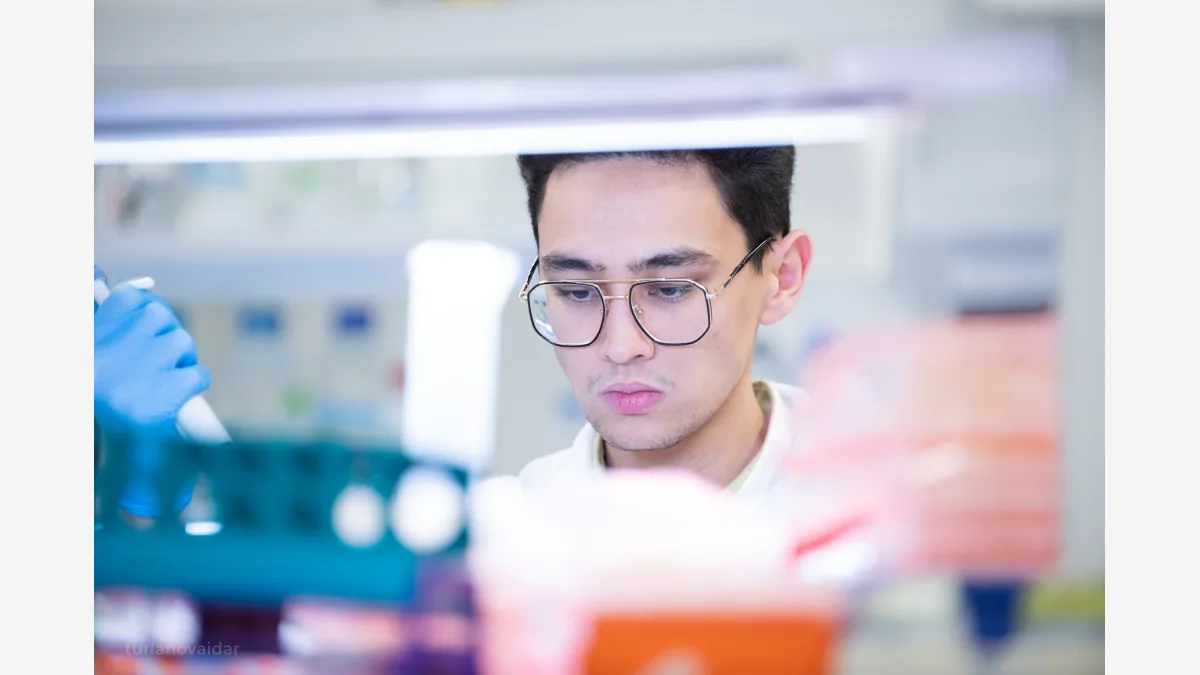
Anthropic has confirmed it operates a wet biology laboratory in the San Francisco Bay Area where its models help design and run physical experiments, moving the company's life sciences work off the screen and onto the bench. The lab was disclosed in interviews with Reuters and confirmed separately to TechCrunch on 18 September.
Eric Kauderer-Abrams, who heads life sciences at the company, framed the reasoning plainly: biology's final arbiter is still real laboratory work, and Anthropic is doing that now. The facility runs like a conventional biotech operation, with some research in-house and some conducted with outside partners.
Key takeaways
- Anthropic's Bay Area wet lab conducts physical biology experiments, with the company testing whether Claude can direct robotic systems to run them under minimal staffing.
- The company told TechCrunch the lab's emphasis is fundamental biology rather than drug discovery, a distinction that keeps it clear of pharmaceutical customers it also sells to.
- It follows April's acquisition of stealth AI biotech Coefficient Bio and a new Life Sciences Verification Program granting vetted researchers access to Anthropic's strongest models.
Why an AI lab needs a bench
For the past three years the industry's biology story has been computational: predict a protein structure, propose a binding candidate, simulate a pathway. That work produces hypotheses, not conclusions. Nothing in a large language model's output tells you whether a designed protein folds correctly in a buffer, and no amount of simulation substitutes for the assay that settles it.
A wet lab closes that loop. It also opens a second question Anthropic appears to be probing directly — whether the model can run the loop itself. The company is reportedly testing Claude's ability to instruct robotic systems through experimental protocols with minimal human staffing, while a spokesperson stressed that keeping people in the loop remains a safety requirement rather than a convenience.
The lab did not appear from nowhere. Anthropic acquired Coefficient Bio, a stealth AI biotech, in April, and has since published research on accelerating protein design and improving biomolecular modelling. This week it also opened a Life Sciences Verification Program that gives vetted biology researchers access to its most capable models.
The customer problem underneath the framing
Anthropic was careful about scope, telling TechCrunch the lab focuses on fundamental biology rather than drug discovery. That qualifier is commercially load-bearing. The company counts major pharmaceutical firms among its customers and partners, including a recently announced joint drug-discovery arrangement with Novo Nordisk, and it has already absorbed criticism for shipping products that encroach on what its customers sell.
Reuters framed the same facility as part of a ramping drug program aimed partly at rare disease. Both descriptions can be true at different time horizons, but the gap between them is worth noticing: a platform vendor that also runs experiments is, structurally, a competitor waiting for a reason.
The juxtaposition nobody missed
The disclosure landed awkwardly against Anthropic's own public positioning. Dario Amodei said last week that he believes AI could cure most major diseases within five to ten years, and published a post over the weekend urging the industry to slow down and adopt self-regulation. He has repeatedly named bioterrorism among the most serious risks the technology carries.
That was already a tense combination before the wet lab. The company is still absorbing the fallout from a researcher's resignation over extinction risk, after which its own alignment lead publicly put the odds of AI wiping out humanity this decade above ten percent. Investor Chamath Palihapitiya summarised the optics on X with a joke about the group behind "We're All Going To Die" and "Regulate Me Now" opening a wet lab in San Francisco.
What to watch
The substantive question is not whether the juxtaposition is ironic but whether the safety architecture is real. An organisation that argues biological misuse is a top-tier risk and then builds bench capacity has, in principle, the strongest incentive of anyone to demonstrate rigorous containment — and the most to lose from a lapse. What has not yet been published is the detail: which experiments run there, what the robotic autonomy tests are permitted to do, and who reviews them.
FAQ
What is a wet lab?
A wet lab is a physical laboratory equipped for experiments on biological or chemical material — cultures, reagents, assays — as opposed to a dry lab, where work is computational. Anthropic's facility puts physical experimentation alongside the modelling work it already does.
Is Anthropic developing its own drugs?
The company says the lab's focus is fundamental biology rather than drug discovery, a position that keeps it from competing directly with pharmaceutical partners such as Novo Nordisk. Reuters characterised the facility as part of a broader drug program, so the boundary may prove less fixed over time.
Does Claude run the experiments autonomously?
Not currently. Anthropic is testing whether its models can direct robotic systems through experimental protocols with reduced staffing, but the company says human involvement remains a safety requirement rather than an optional step.