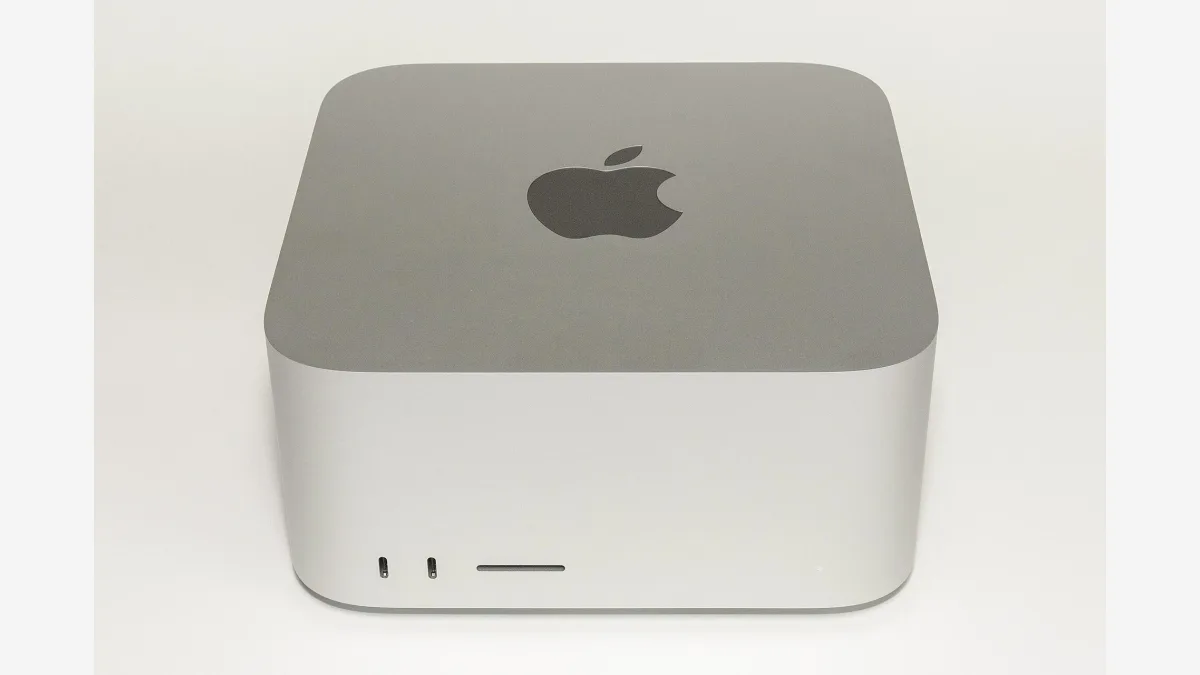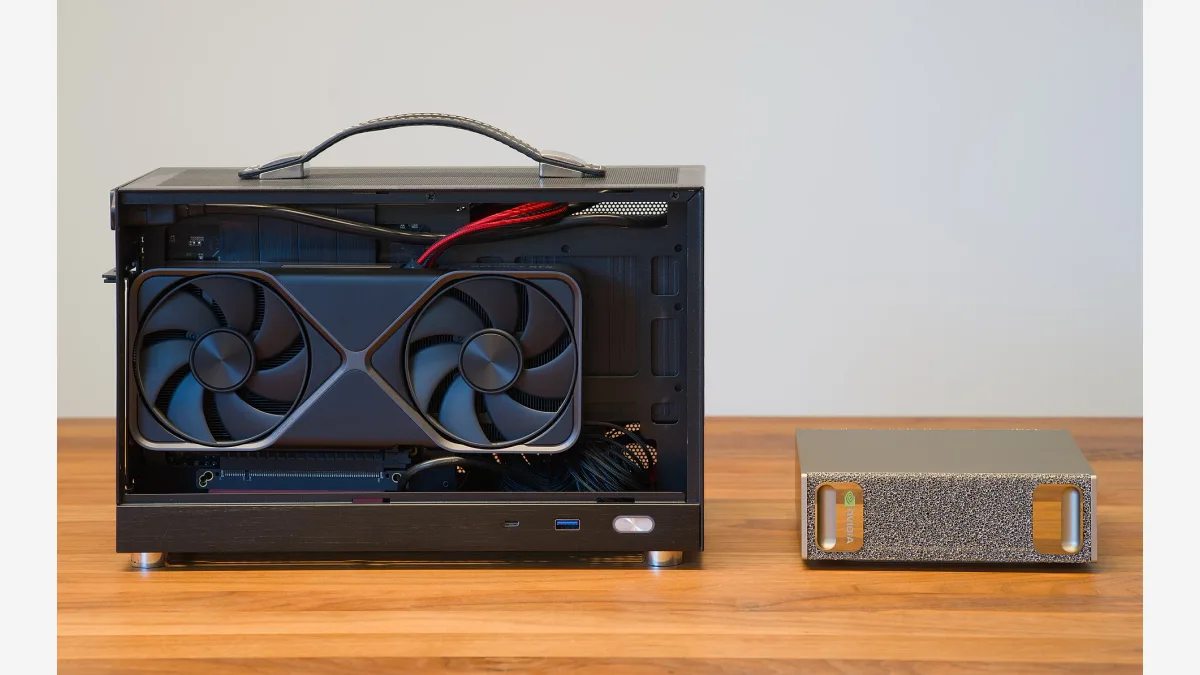
Nvidia is shipping a 64GB configuration of DGX Spark on Friday, Oct. 23, sold exclusively through Acer, ASUS, Dell, Gigabyte, HP and MSI, starting at $4,999. The company frames it as keeping the platform at an accessible price point. The comparison that matters is less flattering: the full 128GB DGX Spark sold for about $4,000 at launch, so the half-memory model now costs roughly 25 percent more than the complete machine did a year ago.
Key takeaways
- DGX Spark 64GB arrives Oct. 23 at $4,999 with the same GB10 Grace Blackwell Superchip, 20-core MediaTek Arm CPU, DGX OS and 273 GB/s memory bandwidth as the 128GB model.
- Nvidia raised the 128GB version to $6,950, close to 75 percent above its launch price, which is what makes a halved-memory SKU necessary rather than optional.
- Two 64GB units cluster over ConnectX-7 to pool 128GB, supporting models up to 200 billion parameters and delivering up to 1.7x the performance of a single unit in Nvidia's own Qwen3.8 27B test.
What you give up at 64GB
The silicon is identical. Nvidia kept the GB10 Grace Blackwell Superchip, the 20-core Arm processor from MediaTek, ConnectX-7 networking and the full CUDA software stack, and the memory bandwidth stays at 273 GB/s — which tells you the company used lower-capacity LPDDR5x modules rather than fewer of them. Storage is also halved.
What shrinks is headroom. A single 64GB unit supports models up to 100 billion parameters on device, against 200 billion for a clustered pair. The Register notes the smaller capacity is a poorer fit for fine-tuning, where memory pressure is highest. Nvidia's counterargument is that local inference is the real workload, and that open models in the 26 to 35 billion parameter range — it cites Qwen3.8 27B — are now capable enough to run private agents.
The clustering story
Nvidia is leaning on expandability to soften the capacity cut. Every DGX Spark ships with a ConnectX-7 NIC, and two units connect directly with a QSFP cable to pool memory to 128GB at twice the bandwidth, with up to 1.7x the throughput of one unit on Nvidia's Qwen3.8 27B measurement. The hardware supports clustering up to four GB10 devices at 200 Gbps each.
The new part is that this no longer requires CLI work. Sync Cluster Assistant detects connected units, validates their configuration and sets up the ConnectX-7 fabric automatically, and because every node runs the same stack, nothing needs reconfiguring when a workflow moves from one box to two. A Sync Model Launcher due at the end of the month will download and start Qwen3.8 27B across a cluster and wire it into OpenCode, so a browser becomes the interface.
Why the price floor moved
None of this is really a product decision. Nvidia's GB10 line has drifted upward since it was shown as Project Digits at CES, where it was expected around $3,000 before launching near $4,000. The jump to $6,950 for 128GB tracks DRAM contract prices, not margin ambition, and Micron has warned that supply gets tighter through 2028. Halving memory is the only lever that holds a sub-$5,000 price point under those conditions.
It also complicates Nvidia's consumer plans. RTX Spark notebooks and mini PCs built on the same GB10 silicon are due this fall from Acer, ASUS, Dell, HP, Lenovo, Microsoft and MSI, aimed at general computing rather than AI workloads alone. If a headless developer appliance with 128GB now approaches $7,000, similarly configured laptops are a harder sell, and Nvidia is expected to offer lower-memory variants for price-sensitive buyers.
Outlook
The competitive pressure comes from AMD's Gorgon Halo SoCs, which span roughly 32GB to 192GB in the top Ryzen AI Max+ 495 parts and currently ship in systems priced below the 128GB DGX Spark. AMD wins on maximum capacity; the Register's testing has consistently found the GB10 GPU substantially faster on AI work. For developers, the practical question is whether 64GB plus a clustering path beats buying more memory once. Two 64GB units cost $9,998 to reach the capacity a single 128GB box covers for $6,950, so the clustering pitch only pays off for someone who genuinely starts small and grows later. The deeper shift is that a desk-side AI appliance is no longer priced by its compute at all; it is priced by its DRAM, and that makes the buying decision a bet on a commodity market rather than on a product roadmap.
FAQ
How much does DGX Spark 64GB cost and when can I buy it?
It starts at $4,999 and goes on sale Friday, Oct. 23, exclusively through Acer, ASUS, Dell, Gigabyte, HP and MSI. Nvidia is not selling this configuration directly.
Is the 64GB model slower than the 128GB version?
Not on paper. It uses the same GB10 Grace Blackwell Superchip, the same 20-core MediaTek Arm CPU and the same 273 GB/s memory bandwidth, because Nvidia used lower-capacity LPDDR5x modules instead of fewer of them. The limit is capacity: 100 billion parameters on one unit versus 200 billion on a clustered pair, and less headroom for fine-tuning.
What do I need to cluster two units?
A QSFP cable between the units' built-in ConnectX-7 ports, and Nvidia's Sync app. The Cluster Assistant feature detects the second unit, validates its configuration and sets up the 200 GbE fabric without manual network or vLLM configuration.