
EPFL Chip Uses AI to Read Brain-Region Sync
EPFL said on Oct. 23 that its LogSync implantable chip uses machine learning on brain-region synchrony to classify cognitive and emotional states and trigger stimulation, while drawing under 200 microwatts.
Researchers at Switzerland's EPFL have built an implantable chip that uses machine learning to read how different brain regions synchronize and to trigger stimulation when it detects specific cognitive or emotional states, the school said on Oct. 23. The chip, called LogSync, measures about 4 by 2 millimeters and runs on less than 200 microwatts, according to EPFL.
Key takeaways
- LogSync extracts two kinds of biomarkers on the chip, oscillation strength and cross-regional synchrony, and a machine-learning algorithm classifies brain states from them.
- On human recordings from earlier psychiatric experiments, the algorithm distinguished cognitive engagement and emotional arousal from neural data alone.
- The work, published in the IEEE Journal of Solid-State Circuits, is backed by a CHF 6.6 million grant from the U.S. National Institute of Mental Health.
How the LogSync brain chip works
The system-on-chip records brain activity and computes network-level features in hardware, rather than sending raw signals to an outside computer. It tracks how strongly brain rhythms oscillate and how closely signals from separate regions move in step.
A machine-learning classifier then uses those features to infer a person's cognitive or emotional state. When it detects a target state, the chip can generate a trigger for stimulation.
The project comes from the Integrated Neurotechnologies Lab led by Mahsa Shoaran at EPFL's School of Engineering and Neuro-X Institute. The paper, "LogSync: A Low-Power Logarithmic SoC for Cross-Regional Synchrony Extraction and Adaptive Psychiatric State Classification," lists Daney Alex as first author.
Why brain-region synchrony matters for psychiatry
The design rests on the premise, in Shoaran's words, that "psychiatric disorders arise more from disruptions in communication between brain regions." Measuring synchrony across regions is meant to capture that communication.
To fit inside an implant's tight power budget, the team built the algorithm and circuits together. "Our entire system is co-designed," Shoaran said.
What the tests showed
The team used two human datasets from earlier psychiatric experiments: one recorded cognitive engagement during a mental task, the other emotional arousal while participants watched video clips. The algorithm told these states apart using neural recordings alone, EPFL said.
In rat experiments at the University of Minnesota, the implant tracked ongoing brain oscillations and triggered stimulation at predefined phases. EPFL did not report a channel count or a classification accuracy figure for LogSync.
Context: from always-on to adaptive stimulation
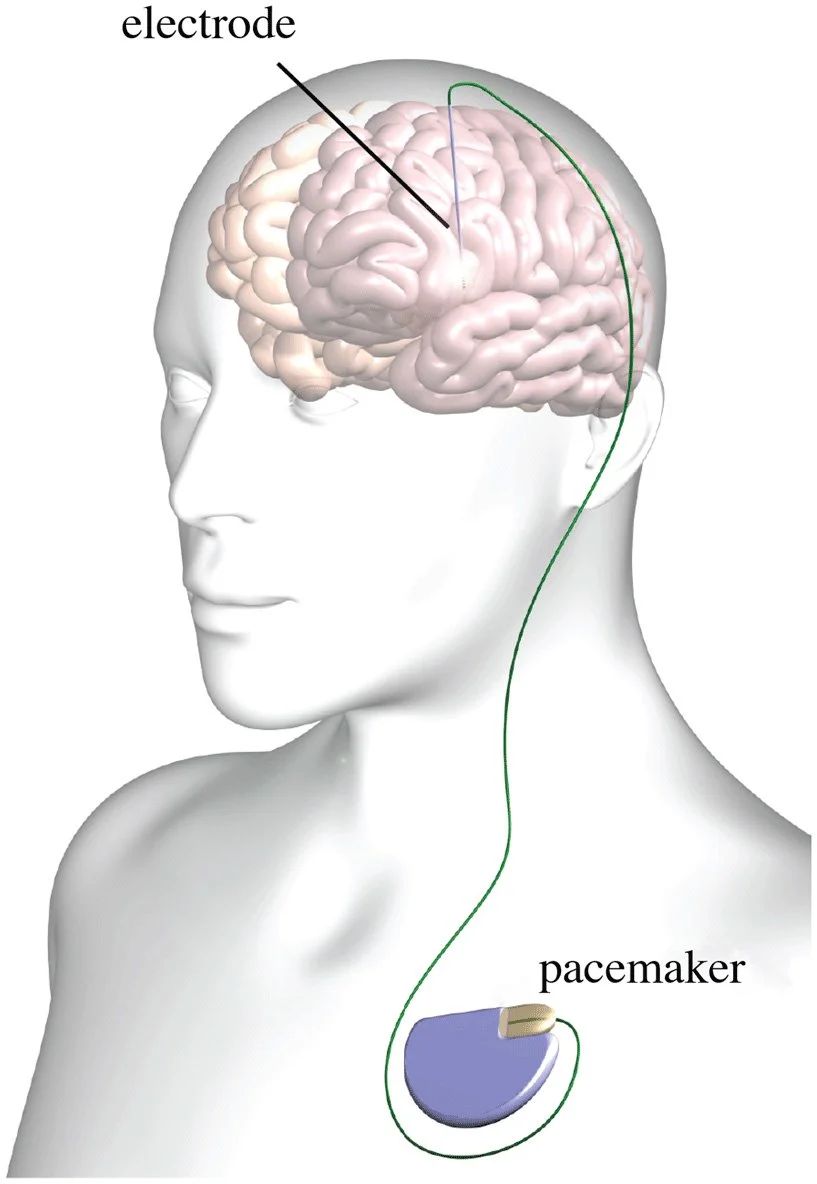
Today's deep brain stimulation (DBS) sends electrical pulses to specific brain areas through implanted electrodes, powered by a generator in the upper chest, according to the National Institute of Mental Health. NIMH says DBS was first developed for movement disorders such as tremor and Parkinson's disease.
The FDA has cleared DBS for severe, treatment-resistant obsessive-compulsive disorder under a Humanitarian Device Exemption, NIMH says. For depression, DBS received Breakthrough Device Designation in 2022 but remains experimental.
LogSync builds on the lab's earlier work. A 2025 paper by largely the same team, presented at the IEEE VLSI Symposium in Kyoto, described a 32-channel chip drawing 196 microwatts for brain connectivity extraction and psychiatric symptom classification, according to EPFL's Infoscience repository.
What's next
The team plans to apply the approach to adaptive DBS for movement disorders, closed-loop non-invasive stimulation and focused-ultrasound interfaces. The lab is also developing machine-learning methods that learn directly from raw neural recordings instead of predefined biomarkers, including a self-supervised model called RECTOR presented at ICML 2026.
Shoaran co-founded Infera Neuro, an EPFL spin-off working toward clinical use of the lab's methods.
FAQ
Is LogSync approved for use in patients? No approval was announced. EPFL reported tests on existing human datasets and in rats, not a clinical trial.
How is it different from standard deep brain stimulation? Conventional DBS delivers continuous stimulation. LogSync is designed to detect specific brain states on the chip and trigger stimulation only when they occur.
Where was the research published? In the IEEE Journal of Solid-State Circuits, with the paper dated September 2026.
References
- Neural chip decodes interactions between brain regions — EPFL (Oct. 23, 2026)
- Brain Stimulation Therapies — National Institute of Mental Health (last reviewed March 2024)
- A 32-Channel 196-μW Logarithmic SoC for Brain Network Connectivity Extraction and Adaptive Psychiatric Symptom Classification — EPFL Infoscience (2025)
Editor responsible for AI Newsway. Writes about AI, developer tools, cloud and productivity technology.

Comments 0
Comments are currently disabled.