
Google Adds TPU 8tx, 8i Max for AI Agents
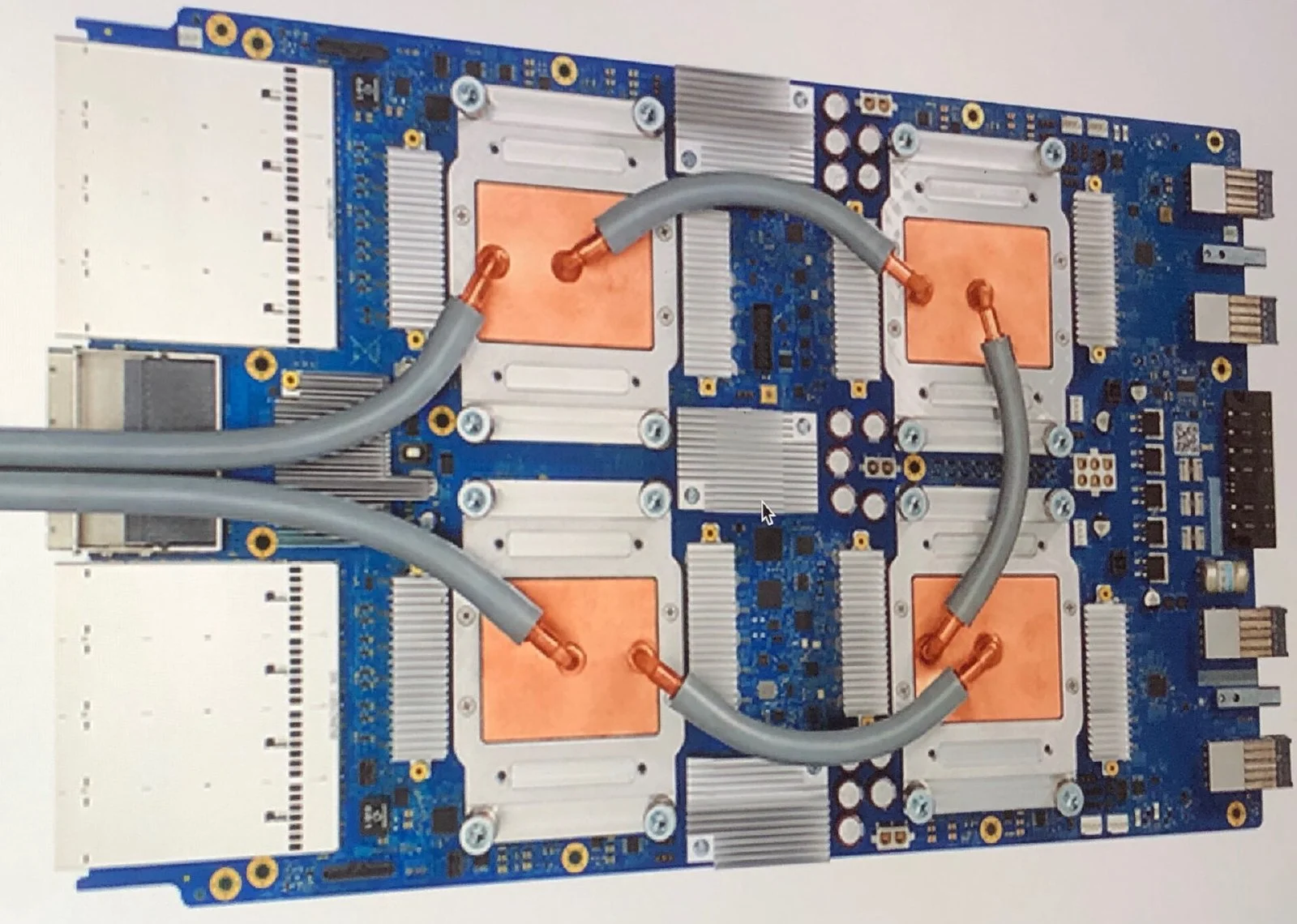
Google on Nov. 9 added TPU 8tx, which keeps data and model weights protected while in use, and TPU 8i Max, which pairs two TPU 8i chips to double compute, SRAM and HBM bandwidth for long-context agent workloads. It is the first time Google has introduced four TPU systems in a single year.
Google on Monday, Nov. 9, added two systems to its eighth-generation Tensor Processing Unit lineup: TPU 8tx, built to keep data encrypted while AI models process it, and TPU 8i Max, which puts two inference chips on one package to handle very long context windows. In a company blog post, Amin Vahdat, Google's SVP and chief technologist for AI and infrastructure, said it is the first time Google has introduced four TPU systems in a single year.
Key takeaways
- TPU 8tx uses the same silicon as the TPU 8t training chip, pairs it with 5th Generation AMD EPYC hosts and protects data and model weights even while in use.
- TPU 8i Max combines two TPU 8i chips, doubling compute, SRAM and HBM bandwidth in the same rack footprint.
- Google did not publish pricing or an availability date for either system in its announcement.
What is Google TPU 8tx?
TPU 8tx targets confidential computing. Data is normally encrypted when stored or sent over a network but must be unlocked in memory while a computer works on it. Google says TPU 8tx builds security into the hardware layer so that sensitive data and model weights stay protected and isolated during processing.
The system borrows the low-latency Boardfly network Google built for TPU 8i. Google claims up to 2x lower latency than TPU 8t "with a near-zero performance penalty." It is aimed at regulated enterprises and governments, which Google says can fine-tune models on private data, distill large models into smaller ones and train agents with reinforcement learning on one system without moving data between clusters.
TPU 8i Max and the memory wall
TPU 8i Max addresses what Google calls the memory wall: when many agents work across a whole codebase or hours of video, memory bandwidth becomes the bottleneck before compute does. Google's answer is two TPU 8i chips on a single package, giving double the compute, double the SRAM and double the HBM bandwidth of one TPU 8i.
Because it fits twice the silicon into the existing rack footprint, Google says data centers can deploy more computing power per square foot and per watt. "With computing moving from human to agent scale, businesses are asking for accelerators that can reason across AI models' massive context windows," Vahdat wrote.
New TPU software for agents
Google paired the hardware with software updates. It is open-sourcing TPU Sync, a layer that tiers KV caches across chip memory, host DRAM and storage; Google says it cuts KV transfer latency and time to first token by more than 90%. A new Agent Compute Engine suspends and resumes idle agent sessions to cut costs.
Cloud Pathways and GKE dynamic slicing are now generally available on Google Kubernetes Engine. Google says dynamic slicing speeds job startup by up to 5x and fault recovery by up to 4.5x. A TPU agent suite, in preview, plugs into coding tools such as Claude Code, Cursor and Google Antigravity to automate onboarding and tuning.
Context: four TPU systems in one year
Google unveiled TPU 8t for training and TPU 8i for inference at Cloud Next in April. It says they offer up to 2.7 times better training performance and 80% better inference price-performance, respectively, than the previous generation. Google says TPUs now have nearly 100 customers.
TPUs are also spreading beyond Google Cloud. Oracle said in October that it will offer TPU 8t and TPU 8i on its cloud from 2027, as hyperscalers keep buying Nvidia hardware at scale, including Amazon's tripled order for 2 million Nvidia GPUs.
What's next
The open questions are when customers can rent TPU 8tx and TPU 8i Max, in which regions and at what price. Google's post did not say. Independent benchmarks of the confidential-computing overhead will also matter, since the "near-zero" penalty figure is Google's own claim.
FAQ
What is the difference between TPU 8tx and TPU 8t? TPU 8tx uses the same silicon as TPU 8t but adds hardware-level confidential computing, AMD EPYC hosts and the Boardfly network. Google says it is for secure inference and small-scale training.
How much faster is TPU 8i Max? Google says it doubles compute, SRAM and HBM bandwidth compared with a single TPU 8i. It has not published workload benchmarks for the new system.
When will the new TPUs be available? Google did not give a date or pricing in its Nov. 9 announcement.
References
- Our newest TPUs: 8tx and 8i Max, built for the agentic era — Google (Nov. 9, 2026)
- Google expands eighth-generation TPU portfolio with two new "TPU systems" — Data Center Dynamics
- Google announced two new versions of its eighth-gen AI chips. — The Verge (Nov. 9, 2026)
Editor responsible for AI Newsway. Writes about AI, developer tools, cloud and productivity technology.


Comments 0
Comments are currently disabled.