
DEEP Robotics Details 5 Robot Brain Projects
DEEP Robotics on Oct. 24 detailed five research projects behind DEEPRobotics-Brain, its embodied AI stack, spanning a world model, a vision-language-action model, an RL method, a navigation agent and an outdoor robot benchmark. The company said the RL method raised real-world navigation success on its LYNX M20 robot from 25% to 65%. The figures come from a sponsored press release and have not been independently verified.
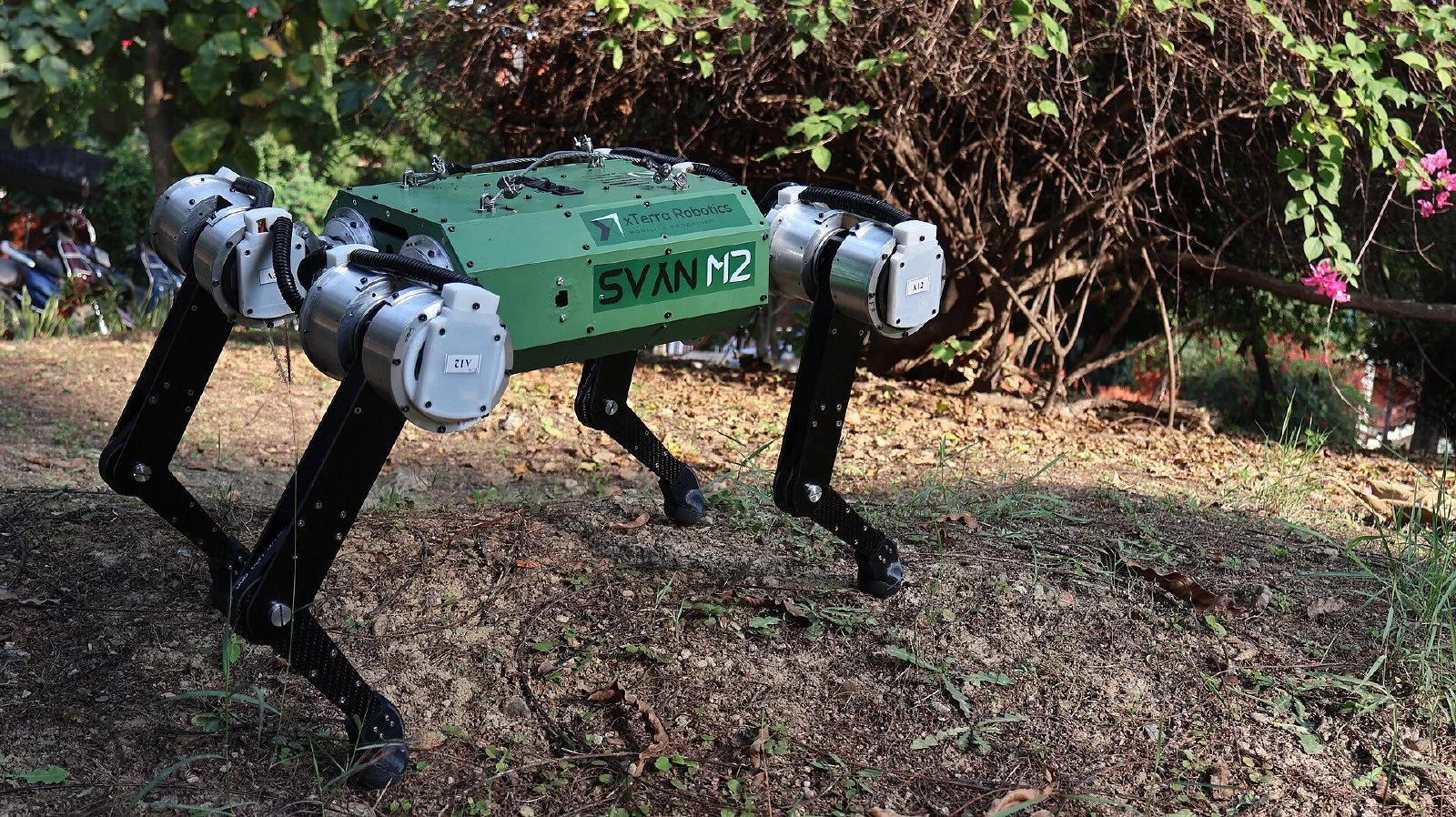
Chinese robot maker DEEP Robotics on Oct. 24 detailed five research projects behind DEEPRobotics-Brain, the AI stack it is building to help legged robots work in changing environments. The company said one of them, a reinforcement learning method, raised real-world navigation success on its LYNX M20 wheel-legged robot from 25% to 65%.
Key takeaways
- The five projects cover a world model, a vision-language-action model, an RL training method, a navigation agent and a real-world benchmark.
- Most figures are self-reported in a sponsored press release. The release names no license and does not say the code or data are open.
- One paper, on navigation in changing scenes, is publicly posted on arXiv with university co-authors.
What DEEP Robotics announced
The announcement, distributed by GlobeNewswire under a Boston dateline, lists collaborators including Zhejiang University, Tsinghua University, MIT, UIUC, UC San Diego and HKUST. It contains no quotes from named executives or researchers.
| Project | What it does | Headline figure |
|---|---|---|
| DR-WM-1.0 | World model that adds friction, roughness and stiffness to action prediction | 2.58 million image-mask pairs, 100,000+ real-robot clips |
| DR-VLA-2.0 | Foundation model pretrained on human first-person video | 14.6% lower heading error on its own test split |
| DR-APO | RL method for diffusion and flow-matching policies | Real-world navigation success 25% to 65% |
| DR-Agent | Navigation agent that tracks where objects may have moved | Benchmark of 803,680 task instances |
| DR-Benchmark | LynxScenes outdoor robot dataset | 833.6 hours, 3,294.7 km of operation |
How the robot world model and VLA work
DR-WM-1.0 aims to judge whether a planned move is physically feasible, not just visually plausible, by modeling contact between robot and terrain. DR-VLA-2.0 first learns from EgoLynx, a set of 10,000 hours of curated first-person web video plus 2,000 teleoperated robot clips, then adapts with robot demonstrations.
The company said a motion-coding scheme with 13 "motion atoms" per arm reached 87.8% normalized task progress in two-armed tasks with unseen layouts. With force feedback, progress was 78.5% on a drawer-and-plug task and 75.2% on vase wiping.
Navigation in a changing world
DR-APO post-training lifted simulated navigation success from 70.33% to 89.55%, the release said. DR-Agent builds on EvolvingNav, described in an arXiv paper first submitted Sept. 30 by researchers from Zhejiang University, UC San Diego, DEEP Robotics and CUHK. The paper reports a 61.32% first-inspection success rate on its EvoWorld-Bench, versus 45.33% for the DynaMem baseline.
LynxScenes holds about 100,000 navigation clips and 3 million annotated frames, and the company said it evaluated 25 models on it.
Context: a Hangzhou robot maker heading to market
Founded in 2017 by Zhejiang University professor Zhu Qiuguo and Li Chao, DEEP Robotics had its application for a Shanghai STAR Market listing accepted, Yicai Global reported in May. It booked 2025 revenue of 337 million yuan and its first net profit, 28.7 million yuan. The 33-kilogram LYNX M20 launched in April 2025.
The push mirrors a wider industry bet on world models for robots, a field where general-purpose AI is also being tested physically, as in our report on how GPT-6 Astra finished a real cone course at 0.94 mph.
What's next
The company says preprints are on its developer center. Until code, data and independent tests appear, the gains remain DEEP Robotics' own measurements on largely in-house benchmarks.
FAQ
Are DEEP Robotics' models open source?
The release does not say so and lists no license terms.
Which robot was used in real-world tests?
The LYNX M20 wheel-legged robot, which DEEP Robotics used for both the DR-APO trials and the LynxScenes dataset.
Were the results independently verified?
No. The release is sponsored content, and its distributors state they do not verify its claims.
References
- DEEP Robotics Unveils Five Research Advances in Embodied AI — DEEP Robotics via GlobeNewswire (Oct. 24, 2026)
- Beyond the Remembered World: Predictive 4D Belief for Persistent Navigation in Evolving Worlds — arXiv (Sept. 30, 2026)
- Embodied AI Startup Deep Robotics Moves Closer to Shanghai Listing — Yicai Global (May 19, 2026)
- DEEP Robotics Debuts LYNX M20, Sets Standard for Industry-grade Legged Robotics — Automation.com (April 2025)
Editor responsible for AI Newsway. Writes about AI, developer tools, cloud and productivity technology.



Comments 0
Comments are currently disabled.