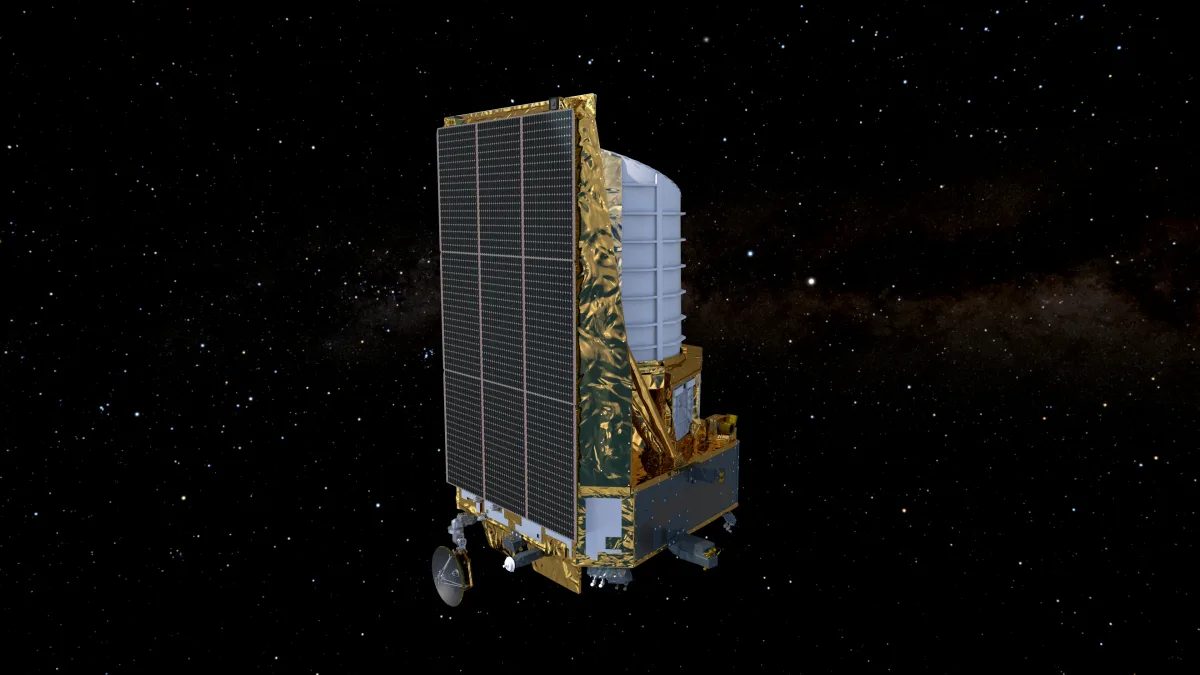
Google is launching a prototype satellite carrying its Tensor Processing Units into low Earth orbit next week, the first in-orbit test for Project Suncatcher, the company's research effort to find out whether machine learning infrastructure can eventually run in space. The satellite flies on SpaceX's Transporter-18 rideshare mission and was built in partnership with Earth-imaging company Planet.
Key takeaways
- The mission's only goal is survival data: how Google's TPUs handle launch vibration, orbital radiation and cooling in a vacuum, not how much useful compute they deliver.
- Google says satellites in low Earth orbit can generate up to eight times more solar power than equivalent panels on the ground, which is the economic premise behind the whole programme.
- Trillium TPUs already survived a total ionising radiation dose larger than a five-year mission during proton beam testing at UC Davis.
Why orbit, and why now
The pitch Google makes in its Project Suncatcher briefing is power, not latency. Satellites in low Earth orbit sit in near-constant sunlight and can harvest up to eight times the solar energy available to a panel on Earth's surface. Chain enough of them together and, in theory, you get machine learning capacity that does not compete with terrestrial grids.
That is a long way off, and Google is unusually direct about it. The programme was announced last year as a moonshot, and this launch is framed as a measurement exercise rather than a capability demonstration. The New York Times, which reported the launch date first, put the flight on a Falcon 9 on October 1, a detail relayed by The Verge. Google's own post names only the Transporter-18 rideshare and says next week.
What Google already broke on the ground
The engineering detail is the more interesting part of the disclosure. A ride to low Earth orbit lasts roughly ten minutes, during which the spacecraft absorbs sustained acceleration loads up to ten times Earth gravity — and individual components such as the TPU chips can see 50 to 100 g. Google shook the satellite on all three axes to reproduce launch frequencies and says the hardware held up better than the team expected.
For radiation, engineers put TPUs in the proton beam at UC Davis's Crocker Nuclear Laboratory and ran AI workloads through them while watching for bitflips. Google reports that its Trillium TPUs tolerated a total ionising dose greater than what a five-year space mission would deliver.
Cooling is the problem with no ground analogue. TPUs concentrate a lot of heat in a small area, and a vacuum offers no airflow to carry it away, so heat has to leave by radiation alone. Google's current approach combines heat pipes and radiators, validated so far only in a thermal vacuum chamber. Whether that design works in orbit is one of the things this flight is meant to answer.
The part that gets tested in 2027
Future Suncatcher satellites are meant to carry dozens of TPU chips each and fly in clusters, which turns inter-satellite bandwidth into the binding constraint. Google plans to link them with lasers, but notes that existing space laser systems are tuned for low bandwidth over long distances — the opposite of what a distributed training or inference cluster needs. It compares the pointing precision required to hitting a coin-sized target from miles away while both ends are moving. Two satellites go up in 2027 to test it.
Context
Orbital data centres have been a recurring pitch from startups for several years, usually accompanied by revenue projections rather than radiation test data. What separates this announcement is that Google is publishing failure modes it has not solved yet, alongside a launch date. The company is simultaneously diversifying its terrestrial accelerator supply, having signed Marvell for custom AI silicon earlier this year.
Outlook
Nothing about this mission changes anyone's compute budget. The realistic outcome is a dataset on bitflip rates, thermal behaviour and mechanical survival that tells Google whether the 2027 two-satellite laser test is worth funding. A prototype that degrades faster than the ground tests predicted would be the most useful result, because it would arrive cheaply. SpaceX rideshare slots have made that kind of disposable experiment economically ordinary, which is arguably the more significant shift.
FAQ
Will this satellite actually run AI workloads in space?
It carries TPUs and will gather in-orbit data on how they behave, but the mission is a hardware survival test rather than a production compute service. Google describes it as gathering data to inform future launches, with the next milestone in 2027.
Why would AI compute be cheaper in orbit?
Google's argument is solar access: satellites in low Earth orbit receive near-continuous sunlight and can generate up to eight times more power than ground-based panels. That advantage has to offset launch costs, radiation hardening and the difficulty of cooling electronics in a vacuum, none of which is settled.
Who is Google working with on the launch?
The prototype was developed with Planet, the Earth-imaging satellite operator, and flies on SpaceX's Transporter-18 rideshare mission. Rideshare flights let small payloads reach orbit far more cheaply than a dedicated launch.