
MedChemBench: GPT-6.2 Astra Scores 84.5%
OpenAI released MedChemBench on Nov. 20, 2026, a 99-problem medicinal chemistry benchmark built from 117 papers and patents. GPT-6.2 Astra scored 84.5% at xhigh, but OpenAI's paper shows top models earn only about half the credit for compound selection and numerical prediction, and only OpenAI models were tested.
OpenAI on Friday, Nov. 20, 2026, released MedChemBench, a 99-problem test of whether AI models can do the reasoning behind early drug discovery. Its newest model, GPT-6.2 Astra, earned 84.5% of the available credit, but OpenAI's own paper shows the top models still collect only about half the points when asked to pick which compounds to advance.
The benchmark asks models to read molecular drawings, weigh lab results and choose compounds, using cases from 117 published papers and patents. OpenAI scored only its own GPT models, and says the results do not show that AI can discover new drugs.
Key takeaways
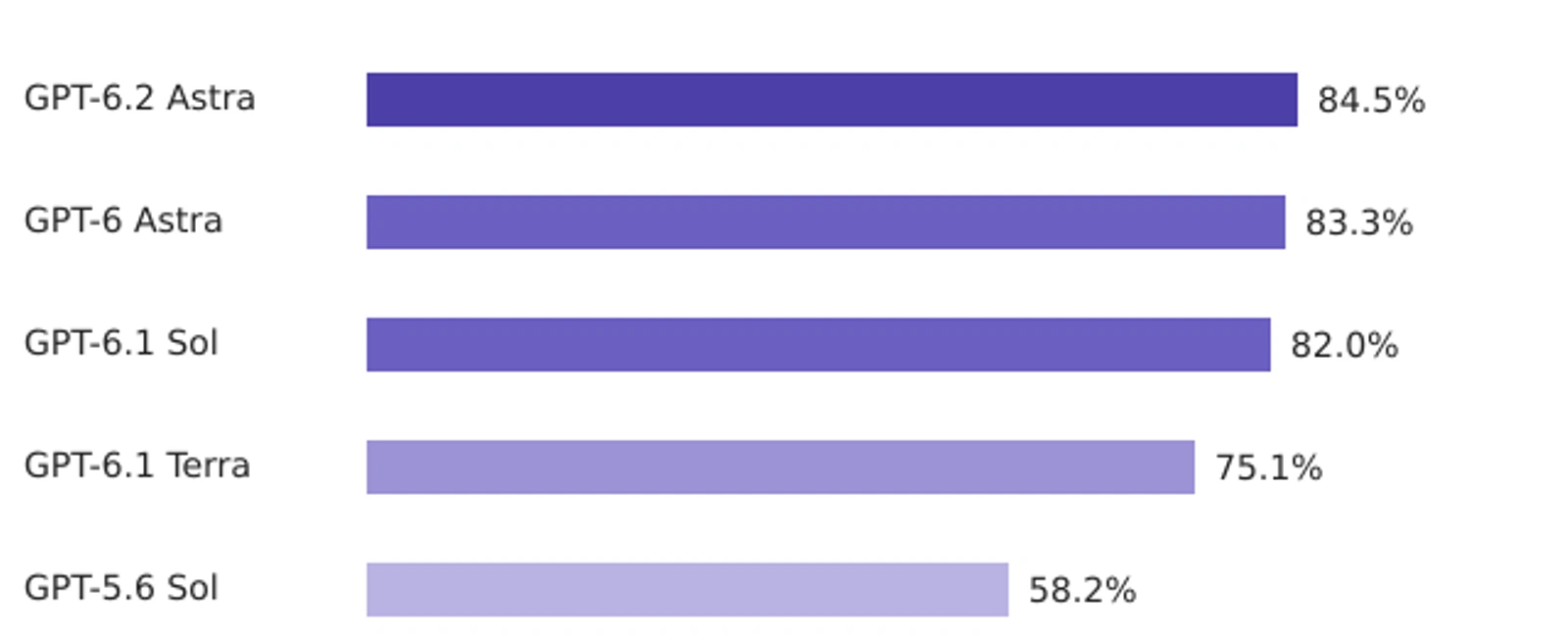
- At the xhigh reasoning setting, GPT-6.2 Astra scored 84.5%, GPT-6 Astra 83.3%, GPT-6.1 Sol 82.0% and GPT-5.6 Sol 58.2%.
- GPT-6 Astra got 95.4% of the credit for rebuilding molecular structures but about 50% for compound selection and numerical property prediction.
- OpenAI says prior exposure to the source papers cannot be ruled out, and its paper calls the benchmark "close to saturation."
What is MedChemBench?
MedChemBench is a retrospective test. Each problem drops a model into a real drug program at a chosen decision point, giving it the biological target, the researchers' goals, the compounds made so far and selected lab data. Results the original authors reported later are withheld and used to grade the answer.
According to the accompanying paper, the 99 tasks span 761 distinct molecular structures and fall into seven categories. Deciding which molecule should move forward makes up 48 of them, and structure-activity forecasting 26. The median source was published in 2025.
How MedChemBench scores AI models
Grading splits into four parts. Writing out molecules correctly as SMILES strings is worth 37.49% of the available score on average. Scientific explanations are worth 35.78% and are graded by a separate GPT-6 Astra judge. Ranking and selecting compounds is worth 17.51%, and numerical or categorical predictions 8.92%. A prediction that is off by a factor of two earns half credit.
Where models fail: structure vs. selection
The widest gap between models is in reading chemistry. In one task based on the program behind the cancer drug candidate daraxonrasib, models had to attach two groups to a large ring scaffold while keeping an 18-atom ring intact. GPT-6 Astra got it right in all 10 attempts. GPT-5.6 Sol and GPT-5.6 Luna failed all 10; one Sol answer produced a 15-atom ring, and a Luna answer split the molecule into two disconnected pieces.
Decisions are harder. At xhigh, GPT-6 Astra scored 95.37% on structures and 91.05% on explanations, but 50.42% on ranking and selection and 47.02% on numerical prediction, the paper shows. Across all 11 models at xhigh, selection scores ranged only from 43.58% to 52.78%.
The paper covers 11 GPT models and 60,390 graded responses; its top score was GPT-6 Astra's 83.83% at max effort.
Context: memorization and limits
Because the cases come from published work, a model may have seen them in training. As a check, OpenAI reran the problems with each source's DOI or patent number added. Scores moved by -0.23 to +0.80 percentage points, which the authors say "cannot establish whether source material was present in training data."
Each answer was a single attempt without tools, feedback or new experiments. "These results do not establish whether models can discover new drugs or improve laboratory decisions," OpenAI wrote. The paper adds that future versions "will need to be more challenging."
What's next
The benchmark covers only OpenAI models so far, so outside labs will need to run it before it works as an industry yardstick. The paper proposes an agent track in which models can look up data, calculate properties and revise answers, plus checks by independent medicinal chemists.
FAQ
Does a high MedChemBench score mean AI can design drugs?
No. OpenAI says the test measures reasoning over historical cases, not real-world drug discovery.
Which models were tested?
Only OpenAI's GPT models: 11 in the paper, with GPT-6.2 Astra's result added in the launch post.
What is the hardest part of the benchmark?
Selecting compounds and predicting numerical properties, where even the best model earned about half the credit.
References
- Can AI help scientists identify promising drug candidates? — OpenAI (Nov. 20, 2026)
- MedChemBench: Evaluating complex multimodal reasoning in medicinal chemistry — OpenAI (paper dated Nov. 9, 2026)
Editor responsible for AI Newsway. Writes about AI, developer tools, cloud and productivity technology.


Comments 0
Comments are currently disabled.