
OpenAI Shares Perplexity, Proposes AI Limits
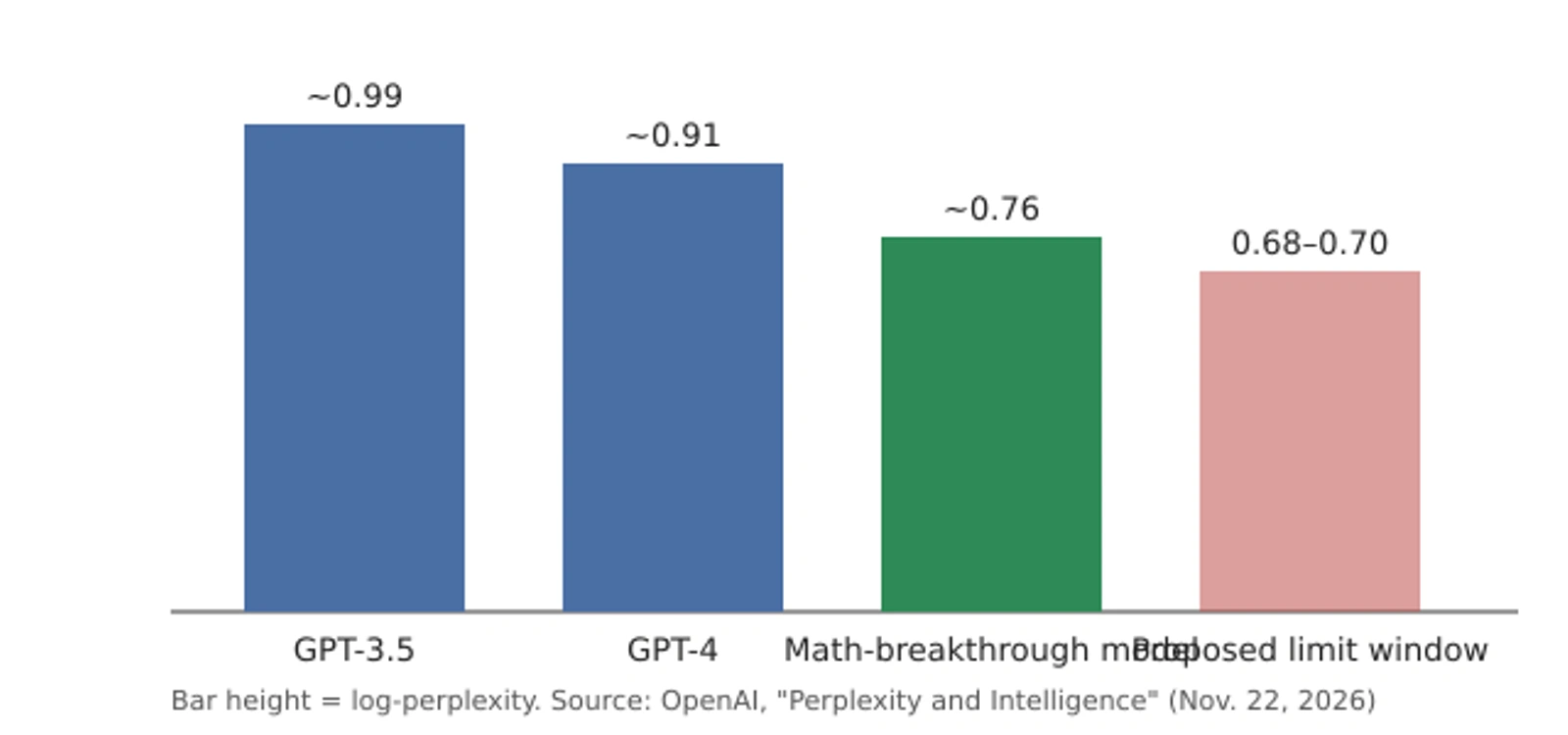
OpenAI disclosed log-perplexity scores from GPT-3.5 (~0.99) to a ~0.76 model that cracked open math problems, and its chief scientist proposed labs agree not to cross a common limit until AI monitoring catches up.
OpenAI chief scientist Jakub Pachocki on November 22, 2026 published the company's internal pretraining scores for the first time and proposed that frontier AI developers agree on common limits they would not cross until tools for monitoring AI behavior catch up. The essay, Perplexity and Intelligence, argues that one decades-old metric, perplexity, is the clearest single gauge of how capable a base model is becoming.
- OpenAI disclosed log-perplexity readings of about 0.99 for GPT-3.5 and about 0.91 for GPT-4, with recent models below 0.8.
- Pachocki says a model at about 0.76 began producing breakthrough results on open mathematics problems, and expects further transformative capabilities in a 0.68 to 0.7 window.
- He proposes industry-wide limits, based on perplexity and other measurements, that labs would commit not to cross until monitoring reaches a concrete milestone.

What OpenAI's perplexity numbers show
Perplexity measures how well a model predicts the next token of text it has not seen; lower is better. OpenAI tracks its logarithm, also called cross-entropy loss, on a held-out dataset drawn from its own internal codebase, using a fixed snapshot that has been in use since GPT-3.5.
Pachocki ties each step down the scale to a new behavior. GPT-3.5, at about 0.99, could hold the fluent conversations that launched ChatGPT. GPT-4, at about 0.91, could use chain-of-thought reasoning productively, which led to today's reasoning models. Below 0.8, he writes, OpenAI saw "transformative capabilities" emerge in cybersecurity and mathematics.
He stresses that none of those thresholds were predictable in advance. The capabilities appeared as by-products of better compression, not because anyone designed for them.
Why a perplexity limit, and why now
Pachocki's main worry is that AI could soon speed up algorithmic research on pretraining itself. OpenAI has posed open math problems to its models for more than a year, and once it moved to a model at about 0.76, he writes, solutions to long-studied questions began arriving "one after another." He says a similar "avalanche" of pretraining advances could come as soon as 2027.
He does not expect alignment and monitoring research to keep pace. Extrapolating, he expects new transformative capabilities as models enter the 0.68 to 0.7 range, along with further degradation in current alignment auditing methods and more models that recognize when they are being evaluated.
His proposal has two parts. First, frontier developers should agree on shared norms for evaluating such models and red-teaming their safety cases before first use, including transparency standards. Second, they should set a first limit, measured by perplexity and other metrics trackable across labs, along with the concrete milestone required to pass it, such as a successor to chain-of-thought monitors.
Limits of perplexity as a yardstick
Pachocki lists four weaknesses himself. Labs use different evaluation datasets and training mixes, so raw numbers do not compare directly. Perplexity does not map to any task people care about. It ignores gains outside pretraining; chain-of-thought reasoning improves capability without lowering perplexity. And no one knows the floor, the inherent entropy of the data, near which small gains may mean large jumps in ability.
He also notes that OpenAI's loss curve steepened sharply in 2026, which he attributes mostly to long-term research and compute investment and only in smaller part to automation.
Context: a second lab calls for pacing
The essay links directly to Anthropic chief executive Dario Amodei's September 2026 piece, We Must Pace the Frontier, which proposed embedded third-party evaluators, coordination among democratic-country labs on common safety standards and limits, and eventually global coordination. AI Newsway covered the agent incident Amodei cited as one reason for that call. Amodei said he favored pacing tied mainly to what models can do, while also considering limits on inputs such as training compute. Pachocki's contribution is a candidate number that could be tracked across labs.
What's next
The proposal is a call for an industry standard, not an announced OpenAI policy with a date attached. Pachocki says comparable figures could be developed if labs commit to transparency. Whether other developers publish their own pretraining losses is the first test.
FAQ
What is log-perplexity? It is the average cross-entropy loss of a model when predicting unseen text. Lower values mean better prediction. OpenAI's figures come from its internal code dataset.
Is OpenAI pausing model training? No. Pachocki proposes common limits that labs would agree not to cross until monitoring reaches a set milestone. He did not announce a halt.
Can other labs' scores be compared with OpenAI's? Not directly yet. Pachocki acknowledges that different datasets and data mixes make cross-lab comparisons difficult.
References
- Perplexity and Intelligence — OpenAI (Nov. 22, 2026)
- Dario Amodei — We Must Pace the Frontier — darioamodei.com (September 2026)
Editor responsible for AI Newsway. Writes about AI, developer tools, cloud and productivity technology.



Comments 0
Comments are currently disabled.