AMD has signed a definitive agreement to acquire Taalas, a Toronto-based chip startup building silicon that hardwires AI model weights directly into the die. The deal gives AMD a bet on a radically different approach to inference economics at a moment when the cost of serving large models has become the industry's central constraint.
Financial terms were not disclosed. It is AMD's third AI-related acquisition in nine months, following MK1 in November and memory optimization startup Mext in June.
What Taalas Actually Builds
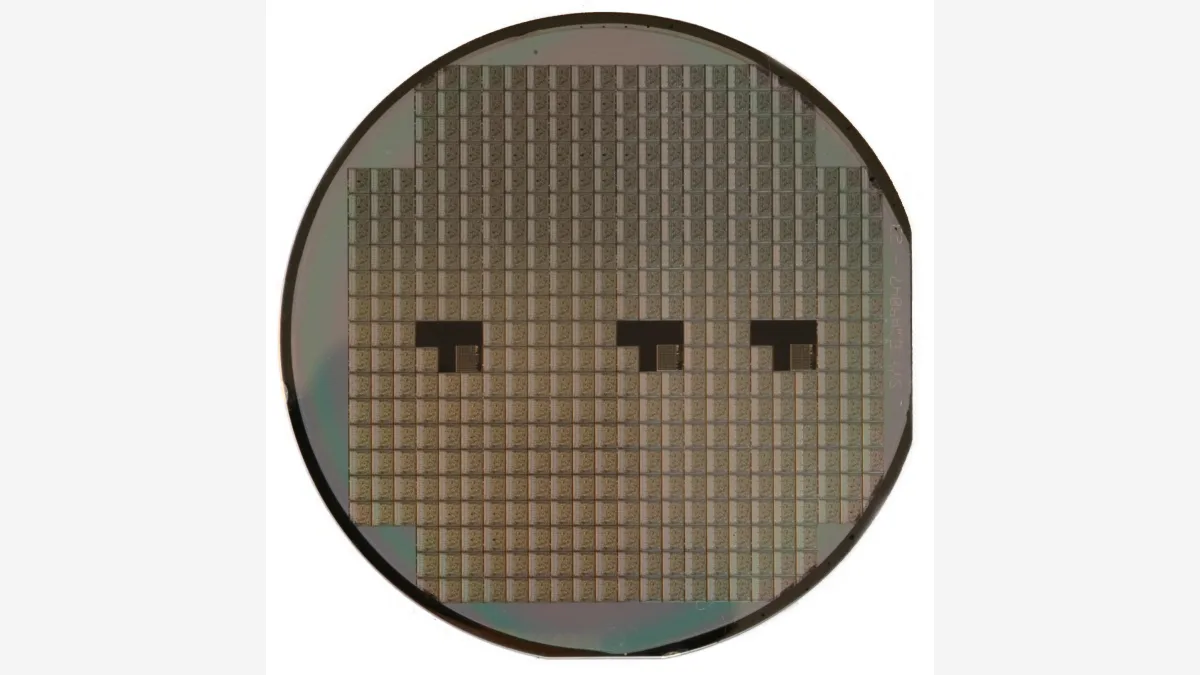
Founded in 2023, Taalas takes an approach that runs against the grain of general-purpose accelerator design. Rather than building a flexible chip that loads model weights from external memory at inference time, Taalas etches those weights into the silicon itself, producing what amounts to a model-specific integrated circuit.
The payoff is the elimination of the memory bandwidth bottleneck that dominates modern inference. Moving weights between high-bandwidth memory and compute units consumes a large share of both time and power in a conventional GPU serving pipeline. A chip that already holds the model in its physical structure sidesteps that traffic entirely.
Taalas emerged from stealth in February with a demonstration chip clocking more than 16,000 tokens per second per user on Llama 3.1-8B, with early technical demos reported at up to 17,000 tokens per second. Those figures are an order of magnitude beyond typical GPU-served throughput for a single user on a model of that size.
The Obvious Catch
The trade-off is equally stark. A chip with a model baked into it cannot run a different model. In a field where flagship releases arrive every few months and fine-tuned variants proliferate constantly, committing silicon to a specific set of weights is a significant wager on that model's staying power.
That constraint shapes where the technology fits. It makes most sense for high-volume, long-lived workloads where a stable model serves enormous request traffic and the per-token economics dominate every other consideration. It makes far less sense for research environments or products that swap models frequently.
A Familiar Playbook
AMD said it plans to fold Taalas technology into its accelerator roadmap and develop system-level products combining it with AMD Instinct GPUs. That pairing hints at the likely architecture: flexible GPUs handling general workloads alongside fixed-function silicon absorbing the highest-volume, most predictable inference traffic.
The move echoes Nvidia's roughly $20 billion licensing arrangement with Groq last December, another bet on specialized inference hardware from a company that already dominates training. Both deals reflect the same underlying shift. Training capacity was the scarce resource that defined the last cycle; inference cost is defining this one, and the economics of serving models at scale increasingly favor silicon designed for exactly one job.
For AMD, which has spent years working to establish Instinct as a credible alternative to Nvidia's data center line, the acquisition offers a lane where it is not simply chasing a competitor's roadmap. Investors reading the deal framed it as an attempt to compete more directly with Nvidia rather than incrementally narrow the gap.
Whether model-specific silicon becomes a mainstream deployment tier or stays a niche for the largest inference providers will depend on how quickly AMD can move Taalas designs from demonstration parts into shipping products, and on whether model release cadence slows enough to make the commitment worthwhile.