Salesforce and Nvidia used the opening of Dreamforce in San Francisco on September 15 to announce Koa, the CRM vendor's first reasoning model, post-trained from Nvidia's open-weight Nemotron 3 Super and run entirely inside Salesforce's own infrastructure. It is the first time Salesforce has stopped renting reasoning from a frontier lab and built it in-house.
Key takeaways
- Koa was post-trained from Nvidia Nemotron 3 Super on a synthetic corpus modeled on 27 years of Salesforce CRM deployments, with no customer data in the training set.
- On Salesforce's internal CRM benchmark, Koa matches or exceeds leading models on CRM actions while producing three times fewer errors.
- Koa is in pilot with 1-800Accountant, Baxter Credit Union, Engine, Formula 1, UChicago Medicine and Xero, with general availability expected in winter 2026 across U.S. regions.
Why Salesforce stopped renting reasoning
Agentforce, the platform where Salesforce customers assemble AI agents for rote work like case routing and appointment scheduling, already shipped a family of small, task-specific models. Reasoning was the gap. Whenever an agent hit a long-running or multi-step problem, Agentforce's model gateway handed the prompt off to Claude or ChatGPT.
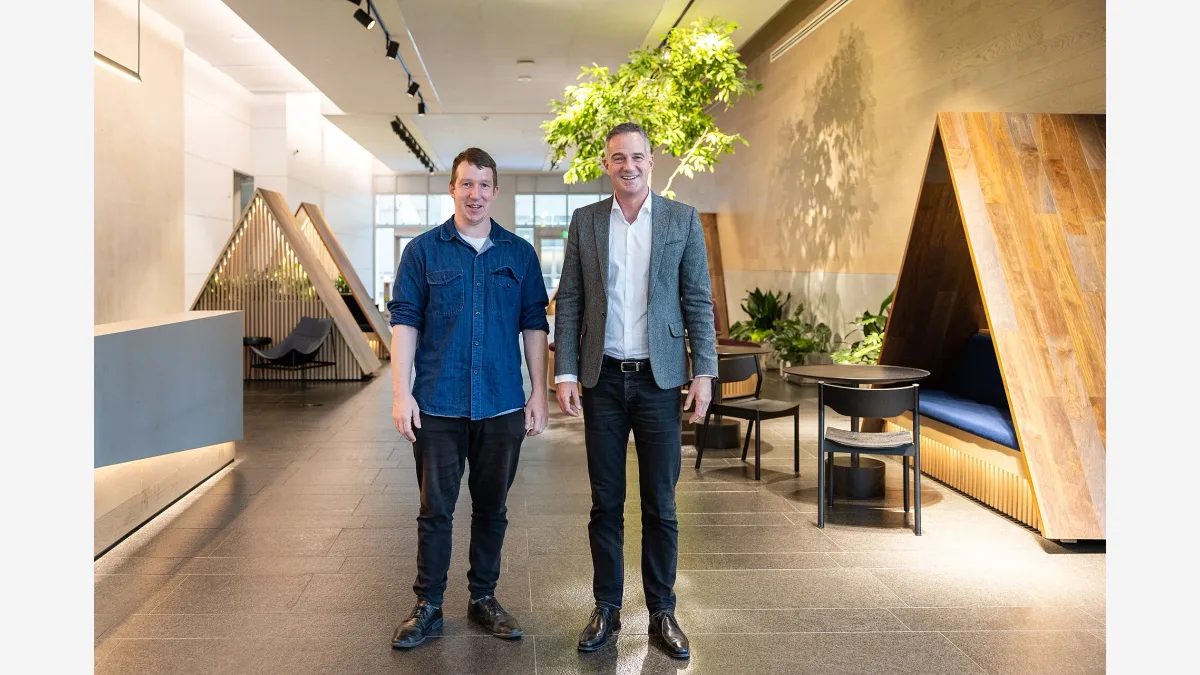
Jayesh Govindarajan, Salesforce's EVP of AI, told TechCrunch that the company had wanted to train its own enterprise-grade reasoning model for some time but lacked a usable starting point. What Nemotron supplied, in his telling, was a base model that was simultaneously American-hosted, state of the art, and transparent about what went into it — a contrast he drew explicitly against Alibaba's Qwen, whose training data he said is unknown.
How Koa was trained without customer data
None of Salesforce's customer records were used. Instead the company generated synthetic scenarios spanning more than 14 industries, including manufacturing, financial services, healthcare and travel. Each scenario paired a persona — an irate caller into a support line, a rep trying to close a deal — with a task, then mapped the exact sequence of actions and tool calls an agent would need to finish it.
The post-training itself combined supervised fine-tuning with reinforcement learning using Group Relative Policy Optimization, run on Nvidia's NeMo RL, NeMo Gym and NeMo AutoModel stack. Salesforce says the narrow task set is what produced the error gap: the model learned not just to answer correctly but to sequence the right actions toward a goal.
What changes for enterprise buyers
The pitch is control and cost rather than raw capability. Salesforce holds the weights and performs both post-training and inference inside its own trust boundary, so no customer data crosses out during a request. Because Koa is tuned for a bounded set of CRM actions, it also burns fewer tokens than routing the same work to a general-purpose frontier model.
Kari Ann Briski, Nvidia's VP of generative AI software for enterprise, framed Nemotron's inference architecture as delivering a combination enterprises need at once — sovereign deployment, fast time to first token, and efficient reasoning economics. Marc Benioff put it in blunter terms, arguing that Salesforce's most valuable asset was never the platform but the accumulated knowledge of how enterprise business runs, and that Koa moves that knowledge inside the model.
The same collaboration extends to Missionforce, Salesforce's public-sector arm, where Nemotron-derived models are being deployed into private clouds, classified networks and fully air-gapped systems for government procurement, supplier management and logistics workflows.
Outlook
Salesforce is not walking away from the labs. Days earlier it announced Claudeforce with Anthropic, letting companies use Claude as their interface while records stay in Salesforce's system. Koa is positioned as another option in the gateway, not a replacement for it. But the direction is unmistakable, and it echoes a broader pattern in which Nvidia's open models keep turning up underneath enterprise agent stacks — as in the 30B Nemotron-and-router pairing the company shipped to cut agent costs. Koa reaches general availability in winter 2026; Missionforce Operations is generally available now, with post-trained Nvidia models opening to select customers in October.
FAQ
Is Koa open source?
No. Koa is built on Nvidia's open-weight Nemotron 3 Super, but the post-trained result is not released. Salesforce controls the weights and runs both training and inference on its own infrastructure, and customers reach the model through Agentforce rather than downloading it.
Was any Salesforce customer data used to train Koa?
Salesforce says no. The training corpus was built entirely from synthetic scenarios designed to mirror how CRM work actually unfolds across industries. The company presents this as the reason Koa cannot leak one customer's data to another.
When can companies use Koa?
Select pilot customers have access inside Agentforce now, including 1-800Accountant, Baxter Credit Union, Engine, Formula 1, UChicago Medicine and Xero. General availability is expected in winter 2026 in U.S. regions.