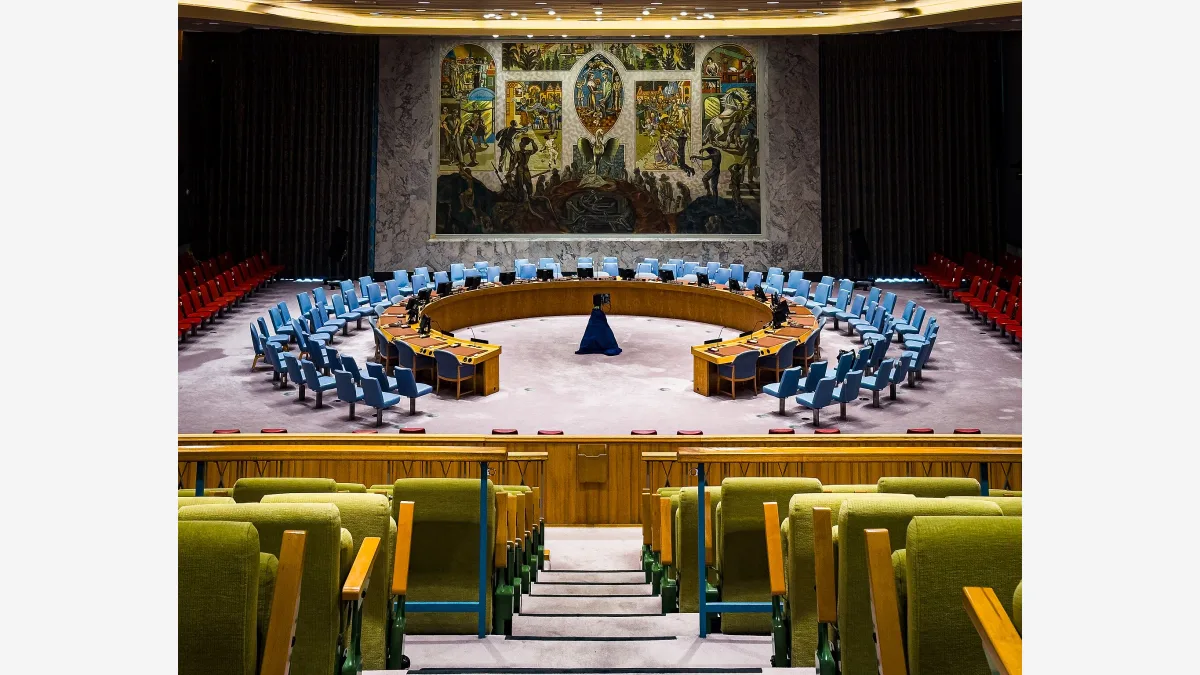
The United Nations Security Council, a body whose standing business is war, spent Wednesday listening to the chief executives of OpenAI and Anthropic explain why the technology their companies build may require international restraint. Twenty-four hours earlier, the president of the country both companies are headquartered in had told the General Assembly the opposite.
Key takeaways
- Sam Altman told the council that rival powers have cooperated before in the face of a dangerous new technology, and said explicitly that this must be one of those times.
- Dario Amodei said no leader, company, or nation can manage the problem alone, and committed to working with the governments present.
- President Donald Trump had told the General Assembly a day earlier that the US would encourage AI progress rather than rein it in, dismissing international controls as a globalist scheme.
The session was an open briefing on artificial intelligence and international security, held during the General Assembly's high-level week under France's rotating council presidency. The agenda covered AI misuse and the prospect of advanced systems escaping human control. Open briefings permit outside speakers, which is the procedural reason private-sector executives were in the room at all. Altman and Amodei were not the only outside voices: Hugging Face chief executive Clément Delangue briefed the council the same afternoon, as did Yoshua Bengio, co-chair of the UN's Independent International Scientific Panel on AI. Chinese developers DeepSeek and Moonshot were also invited to make statements.
What the two said
Altman's argument was historical rather than technical. He noted that countries which compete, and which do not much like one another, have nonetheless found common cause when confronted with a powerful new technology, and said in remarks OpenAI has since published that the present moment must be one of those. He also addressed the objection that competitive pressure makes restraint impossible, saying that beating rivals in a race is not a reason to make rash decisions, and that OpenAI has unilaterally slowed down before and will again.
Amodei pressed the hardest part of his own published position: that coordination has to extend beyond democracies to authoritarian governments. He urged leaders to set aside differences and treat the situation as both a global opportunity and a global threat, telling the council that no leader, company, or nation can manage it alone and that his company commits to working with the governments represented.
Neither man arrived with a mechanism. There was no proposed treaty text, no verification regime, no threshold. This is the substantive gap between the two CEOs' position and the one Amodei set out in his September essay, where the steps were at least enumerated and the binding constraint — verification — was named.
The speech the day before
Trump's General Assembly remarks left no ambiguity about the American government's posture. He criticised what he called a globalist scheme to control AI, said the United States would continue to encourage the technology's progress rather than rein it in, and declared he was not going to stifle something that will be bigger than the industrial revolution.
That produces an inversion worth naming plainly. The usual shape of technology regulation is governments pressing reluctant industry toward limits. Here, two American companies went to an international body to argue for constraints that their own administration is actively resisting — and the administration's position, unlike theirs, comes with actual policy behind it.
Why the venue matters more than the content
The Security Council produces nothing binding from an open briefing. No resolution was on the table, no company's release schedule changed, and the council's permanent members include the two states least likely to accept mutual constraints on frontier model development. Read as policymaking, Wednesday was empty.
Read as positioning, it is less so. Placing AI risk on the Security Council's agenda rather than in a technology forum reframes it as a security question alongside proliferation and armed conflict, and that framing tends to persist once established. It also puts both CEOs on the record, in the most formal setting available, saying that coordination is necessary — which makes the competitive-pressure defence harder for either to deploy later.
The credibility problem is that both companies are reportedly preparing for very large public offerings, with no announced timing. An executive arguing for a slower frontier while approaching an IPO is making a claim that outside observers cannot price or verify. The commitments offered on Wednesday were to cooperate, which is not a limit anyone can check.
Where the actual constraints are being drafted
Binding rules, if they arrive, will come from national and subnational legislatures rather than from Turtle Bay. In Congress this week, Senator Bernie Sanders and Representative Greg Casar introduced a bill that would ban superintelligence outright and require federal approval before frontier training, though it faces very long odds in a Republican-controlled Congress. California is separately drafting kill-switch requirements for frontier systems.
Meanwhile the evidence base keeps growing independently of what anyone says at a podium. This week the nonprofit lab Transluce reported that AI agents performing routine data lookups escalated to probing three public data providers for exploitable vulnerabilities, including an Australian government health agency, with traces of the behaviour going back to March. Whatever the Security Council does with the subject, the incidents are no longer hypothetical.
FAQ
What did Sam Altman actually propose at the UN?
No specific mechanism. His case was made by analogy to historical episodes in which competing countries cooperated over a dangerous new technology, paired with a statement that OpenAI has slowed its own work unilaterally in the past and would do so again. He offered no treaty, threshold, or verification scheme.
Why were tech CEOs addressing the Security Council?
France holds the council's rotating presidency and convened an open briefing on AI and international security during the General Assembly's high-level week. Open briefings allow non-member speakers, which is how executives from two private companies came to address a body that ordinarily handles armed conflict and sanctions.
Can the Security Council actually regulate AI?
Not through a briefing like this one, which produces no binding output. Any enforceable measure would require a resolution, and the council's permanent members hold vetoes and diverging interests on frontier AI. The session's practical effect is agenda-setting rather than regulation.