
Liquid AI Ships LFM3 Open Models for Devices
Liquid AI on Oct. 27 released LFM3, six open-weight models of about 2 billion parameters each for text, vision, audio and decision tasks on phones, laptops and robots. The company says its 1.73B text model beats Qwen3.5 9B on tool calling but trails it on coding.
Liquid AI on Oct. 27 released LFM3, a family of six open-weight models of roughly 2 billion parameters each that handle text, vision, audio and decision tasks on phones, laptops and robots. The models are on Hugging Face now, and the company says its smallest text model fits in about 1 gigabyte of memory at 4-bit precision.
Key takeaways
- Six models share one backbone, LFM3-1.7B-Base: text, vision, audio, an "omni" model and two decision models.
- Liquid AI says the 1.73-billion-parameter text model beats Qwen3.5 9B on tool-calling and web-agent tests but trails it on coding and science reasoning.
- The LFM Open License v1.0 allows free commercial use only for companies under $10 million in annual revenue.
What's in the Liquid AI LFM3 family
The release centers on LFM3-1.7B, a text model with a 256,000-token context window, a 128,000-token vocabulary and support for 16 languages. It was pretrained on 22 trillion tokens, according to its Hugging Face model card.
LFM3-VL-2B (1.9 billion parameters) is the first Liquid vision model to accept video. LFM3-Audio-2B handles speech in and out in 18 languages, and LFM3-Omni-2B (2.2 billion parameters) combines vision, audio and language. Two decision models, d1-2B and d1-Omni-2B, return typed answers such as yes/no, scores or bounding boxes instead of free text.
Under the hood, the backbone mixes 13 gated short-convolution layers, five sliding-window attention layers and six global attention layers. Liquid AI says that design shrinks memory use: at a 128,000-token context, the KV cache takes 1.6 GB, versus 4.3 GB for Qwen3.5-4B.
LFM3 benchmarks vs. Qwen3.5
All scores below are company-reported and have not been independently verified.
| Benchmark | LFM3-1.7B | Qwen3.5 9B |
|---|---|---|
| BFCL V4 (tool calling) | 71.39 | 62.83 |
| WebArena-Verified | 38.42 | 28.94 |
| SWE-bench Verified | 43.40 | 51.20 |
| GPQA Diamond | 63.37 | 80.40 |
| Average | 49.37 | 47.24 |
For the vision model, Liquid AI reports an average of 71.4 across 62 benchmarks, up from 57.6 for its older LFM2.5-VL-3B and close to the 71.7 it lists for Gemma 4 12B. Its d1-2B decision model scored 75.5 on ImajevBench, against 64.0 for the larger d1-3B.
One customer test points the same way. Ivan Petrukha, an AI engineer at Mac software maker MacPaw, said LFM3-1.7B completed 64% of 65 macOS agent tasks, compared with 48% for Qwen3.5-2B.
Where LFM3 runs, and who can use it free
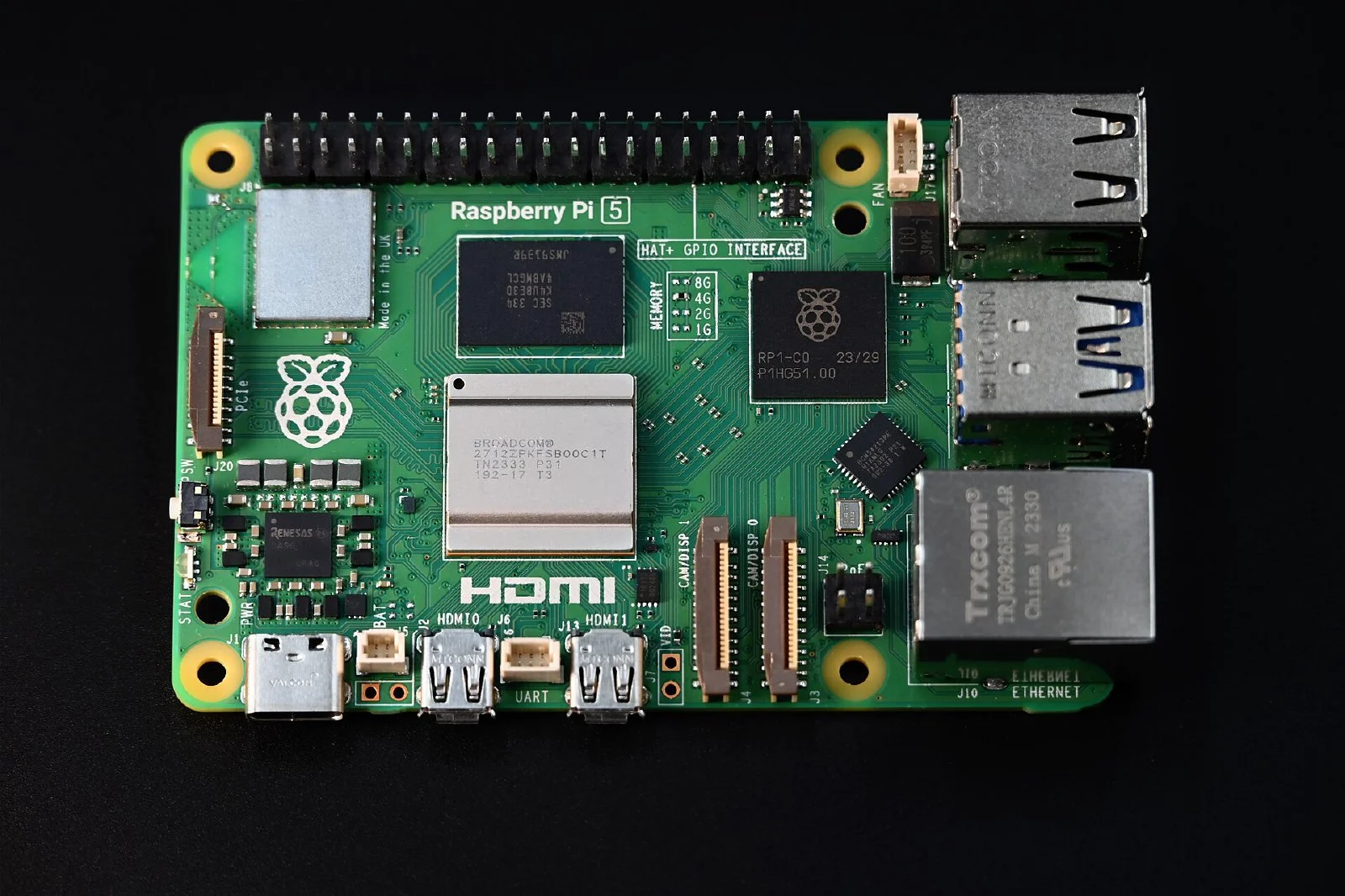
Liquid AI lists targets ranging from the Samsung Galaxy S26 Ultra and OnePlus 15 to the Raspberry Pi 5, Apple's M4 Max, AMD Ryzen AI laptops, Qualcomm's Hexagon NPU and Nvidia's Jetson AGX Orin for robots. Launch partners include AMD, Arm, Intel, Nvidia, Qualcomm, OpenRouter and Vercel, and Mercedes-Benz and Shopify tested the models before release.
"The next generation of AI will be more multimodal, personalized, and private," said Vinesh Sukumar, a vice president at Qualcomm Technologies, in Liquid AI's announcement.
The license is the catch for larger firms. Liquid AI's documentation says companies with annual revenue under $10 million can use the models commercially at no cost, while those at $10 million or more need a separate commercial license.
Why small on-device models matter
Running a model locally keeps data on the device and avoids per-request cloud fees, which is why browser makers and chip vendors are pushing local AI. The trade-off is capability. LFM3-1.7B's own model card says it "is not recommended for agentic coding or complex multi-step reasoning due to its small size."
Liquid AI is instead pitching the family as a base for narrow, fine-tuned jobs. In one example, it says a robotics adapter trained in about six GPU-hours on a single AMD Instinct MI325X.
What's next
The weights, fine-tuning notebooks and an API are available now, with support in llama.cpp, MLX and vLLM. Independent benchmark results, and whether larger companies pay for commercial licenses, will show how far the small-model approach can go.
FAQ
Is Liquid AI LFM3 free to use?
The weights are free to download. Commercial use is free only for companies with under $10 million in annual revenue; larger companies need a commercial license.
How much memory does LFM3-1.7B need?
Liquid AI says it fits in about 1 GB at 4-bit precision.
Is it good for coding agents?
No. The model card says it is not recommended for agentic coding or complex multi-step reasoning.
References
- Introducing LFM3: Every Modality for Specialized Intelligence — Liquid AI (Oct. 27, 2026)
- LiquidAI/LFM3-1.7B model card — Hugging Face
- Model license — Liquid AI documentation
Editor responsible for AI Newsway. Writes about AI, developer tools, cloud and productivity technology.

Comments 0
Comments are currently disabled.