
Microsoft School AI Privacy Rules Take Effect
The National AI Safety & Privacy Standard Microsoft agreed with the AFT and UFT takes effect Nov. 1, 2026, barring training on student and educator data, companion-style AI features and decisions without human review in Microsoft's school AI products.
A contract-based AI safety and privacy standard that Microsoft negotiated with the American Federation of Teachers (AFT) and the United Federation of Teachers (UFT) takes effect Nov. 1, 2026, for U.S. school districts that use Microsoft's education AI products. The rules bar the company from training AI on student and educator data, ban companion-style chatbot features, and let districts write the protections into their Microsoft contracts.
Key takeaways
- The "National AI Safety & Privacy Standard," announced Sept. 9, goes into effect Nov. 1 and is available to every school district nationwide, according to K-12 Dive and Fortune.
- Student and educator data can never be used to train, fine-tune or benchmark models, with only a narrow safety and security exception; that ban survives contract termination.
- The standard covers AI products built for schools and excludes general-purpose productivity tools, so districts need to check which Microsoft products their contracts actually cover.
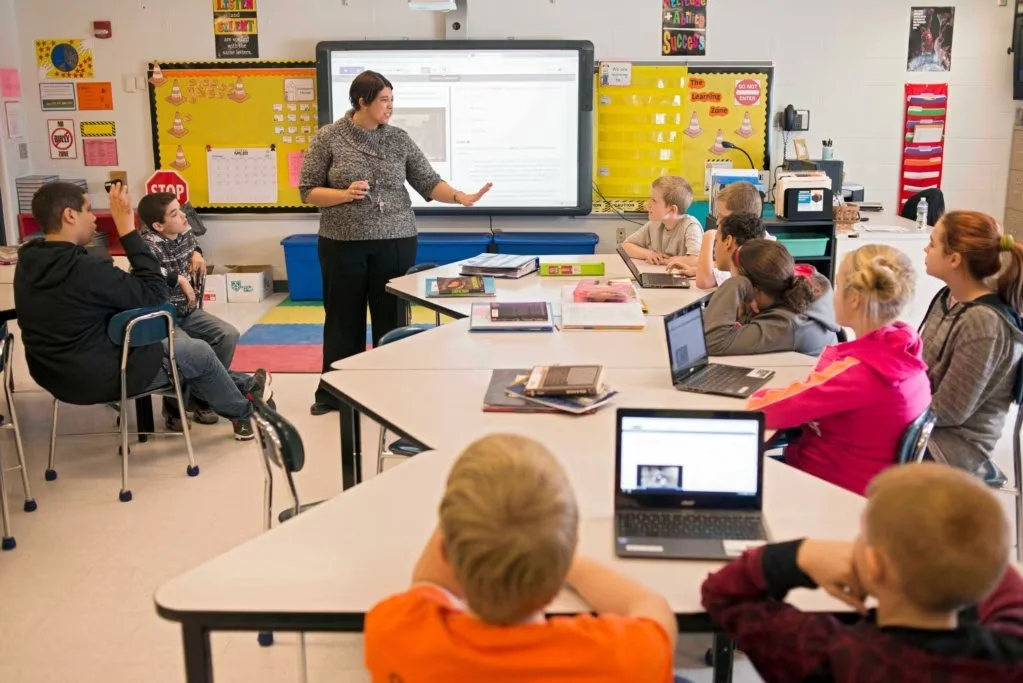
What the Microsoft AFT school AI standard requires
The agreement document published by the AFT is signed by Microsoft Vice Chair and President Brad Smith and AFT President Randi Weingarten, with both signatures dated Sept. 7, 2026. It runs for a two-year term and is organized around 10 principles.
The core rule is that "Covered Data," meaning student data plus data from educators and administrators, may not be used for training, fine-tuning, benchmarking or product improvement, including in de-identified form. The only exception is the minimum data needed to detect harms such as self-harm, grooming, bullying or security threats, and that use cannot feed general model improvement.
Microsoft may not sell or share covered data or use it for advertising or product development. Precise geolocation, keystroke tracking, long-term profiling and biometric or emotion inference require written approval from the school customer.
No AI companions, no automated grading
The standard prohibits companion-style or relationship features designed to foster attachment, simulate friendship or extend engagement beyond the learning task. AI may not make decisions without meaningful human review, and features that take actions on a user's behalf must be possible to switch off for students.
The document also lists uses that are prohibited in instruction at the signing institution: automated grading without review, automated discipline or placement decisions, emotional or psychological assessment, and surveillance aimed at predicting behavior.
Deadlines districts can enforce
Microsoft must report a confirmed or suspected breach within 72 hours. Once a district starts a deletion, active systems must be cleared within 180 days. On request, Microsoft must make the substantive protections available to education customers within 90 days of the effective date.
In its provider notes, Microsoft says it has not yet completed ISO 42001, an AI management certification, and targets Dec. 31, 2027. UFT President Michael Mulgrew said the deal "empowers school districts to end agreements and seek damages from bad actors who break the rules."
Context: why teachers unions pushed for contracts
Weingarten argued that existing privacy laws fall short, saying "HIPAA and FERPA never envisioned the advent of AI" and that "anything less than legally enforceable provisions is simply a wish list." Microsoft's announcement says similar frameworks were adopted by the Los Angeles Unified School District, New York State United Teachers and New York City Public Schools.
The scope has limits. The agreement defines covered products as generative AI services built and marketed mainly for students and educators, and it excludes general-purpose productivity tools. Districts running standard Microsoft 365 or Copilot tiers should confirm in writing which products are covered.
What's next
Smith said Microsoft would "extend this agreement to every school district across the country." Weingarten told Fortune in September that OpenAI and Anthropic had "expressed willingness" to sign similar agreements. An Anthropic spokesperson said the company had been "working with AFT on shaping a gold standard for safety and privacy." Neither company had announced a signed agreement in the public sources reviewed for this article.
FAQ
Does the standard apply to my district automatically? It is available to all U.S. districts from Nov. 1, but it is enforced through each district's Microsoft customer agreement. Districts should confirm with Microsoft that the protections are attached to their contract and which products they cover.
Can Microsoft use any student data at all? Only to run the contracted service, comply with law, protect minors' safety, and for a narrow, auditable safety and security purpose. Training general models on that data is banned permanently.
Does it cover Microsoft 365 Copilot? The agreement excludes general-purpose productivity tools from its definition of covered products, so coverage for standard Microsoft 365 or Copilot tiers is not automatic.
References
- AFT, UFT and Microsoft announce National AI Safety & Privacy Standard for schools — Microsoft (Sept. 9, 2026)
- National AI Safety & Privacy Standard (agreement document) — American Federation of Teachers (2026)
- Microsoft's move in the AI school debate: controls over how student data gets used — Fortune (Sept. 9, 2026)
- Teachers unions announce AI safety agreement with Microsoft — K-12 Dive (2026)
Editor responsible for AI Newsway. Writes about AI, developer tools, cloud and productivity technology.




Comments 0
Comments are currently disabled.